
How I Used Generative Engine Optimisation (GEO) to become AI Visible
It doesn't matter if you use AI in your business or not. It matters that buyers will use AI to find and vet you. Generative Engine Optimisation (GEO) is how you make sure you are found and recommended.

Making my business AI Visible
In March 2026, I took my business from an AI visibility score of 50 to 86. This is how I did it and why it's so important.
About a month ago, I did a deep dive into Generative Engine Optimisation (GEO). I was launching a new site for my Irish practice, and I knew AI visibility mattered. GEO is how you make that happen.
The TL;DR on GEO is that it makes it easier for AI systems to find, understand, and accurately describe your business.
The core idea is signal clarity.
Every piece of missing, inconsistent, or poorly structured information makes it harder for an AI system to resolve what a business is, what it does, and why it should be trusted. When it comes to making these recommendations, AIs are generally risk-averse. If they have doubts, you're out of the running.
And in case you're wondering if all this even matters...
Gartner predicts, "By 2028, 90% of B2B buying will be AI agent intermediated, pushing over $15 trillion of B2B spend through AI agent exchanges."
Deloitte Ireland reports that 64% of Irish consumers were using AI to research and make decisions by 2025, a figure that nearly doubled in just two years.
McKinsey (2026) reports that 67% of UK consumers used at least one AI tool in the last three months for researching and comparing purchases, a figure mirrored across the EU.
Princeton (2024) researchers reported, "GEO can boost visibility by up to 40% in generative engine responses". They also said GEO has "profound implications" for how we market ourselves.
Future buyers will, at the very least, use AI to vet you, and it might be how you get discovered as well.
You need to send the clearest signal possible, so you are seen, understood and recommended, because AI is going to make recommendations. And unlike SEO, where there are pages and pages of results on a search, AI will come back with maybe five names. Everyone else is invisible.
How I Identified Changes to Make and Tracked Progress
As I prepared to start GEO work on my site, I wanted a way to measure progress properly. I wanted consistent benchmark scores I could track as I made changes. So, I built a GEO diagnostic application.
It analyses the technical infrastructure AI crawlers need to read a site, the content structure that determines whether key answers are extractable, and the entity signals that tell AI systems the business is real and credible. Benchmarked, scored, repeatable. It also gave me detailed technical and content recommendations based on best practices in GEO.
Some of what it reported was reassuring, some was new to me, and some of it was ouch.
The before and after picture: Technical GEO
To get a clean comparison for this article, I rolled my site back to its original state before any changes and ran a full audit. I then reloaded my site to the post-changes version and re-audited. That's a back-to-back comparison with zero changes to the application to muddy the waters.
I've run the audit multiple times with the same site version to make sure I'm getting consistent results. There are variations of a single point on some of the score breakdowns, but these are an exception rather than the norm.
What you're looking at below is the top-of-page report for the Technical GEO audit (the rest of the page is a more detailed analysis).
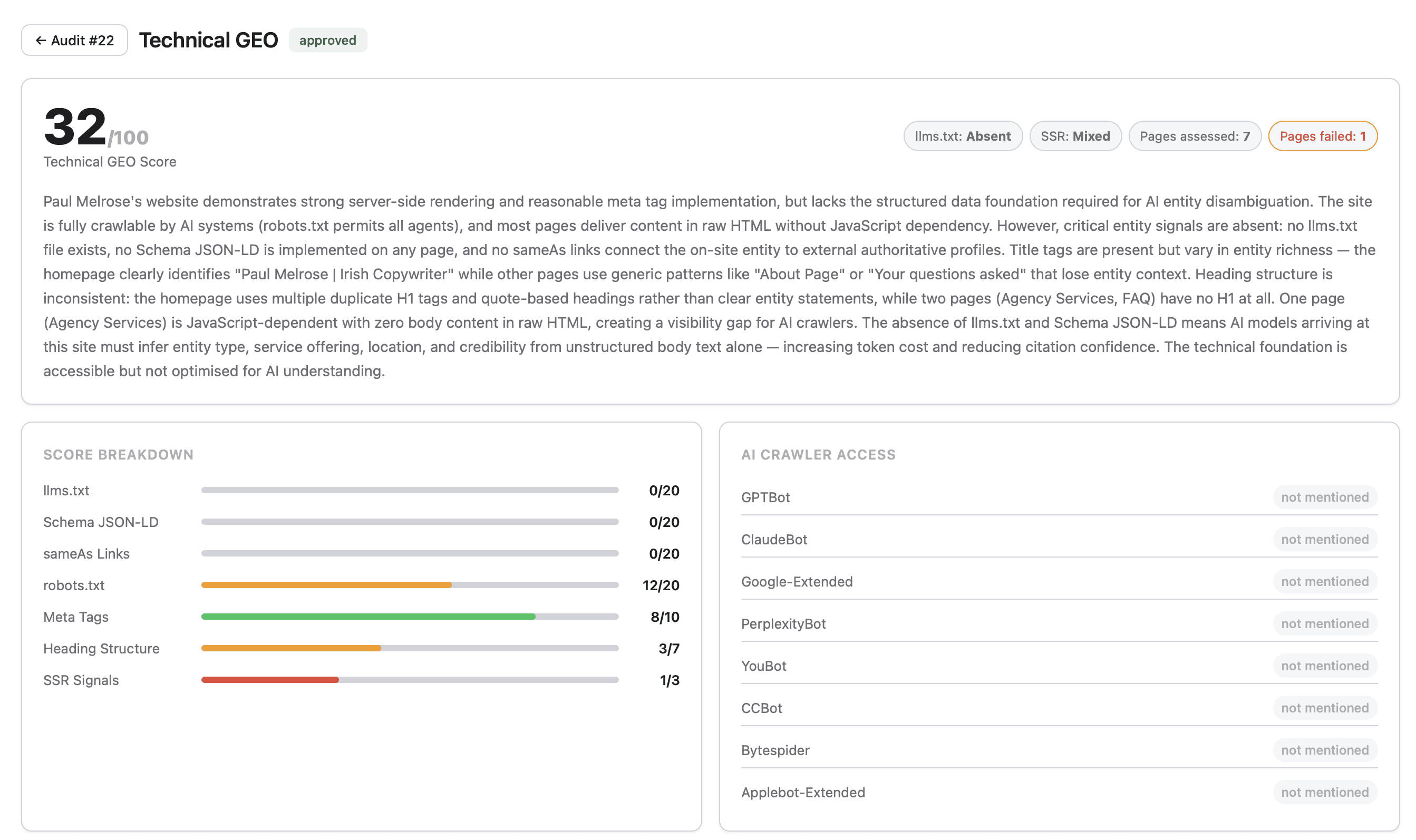
An overall score of 32/100 is low. It means the technical aspects of my site (invisible bits) do not help a visiting AI understand who I am, what I do and who that is relevant to.
The rest of the report made very specific recommendations and I acted on those. I wrote an llms.txt file, JSON-LD files and a robots.txt file. I also did some work on my sameAS list and SSR signals.
(If this is all new to you, it's not that difficult. Most good website hosts will help you make these changes easy enough. But I do recommend taking the time to understand why all this works. That will help you understand how AIs want you to communicate with them.)
I made changes, re-ran the audit, got more feedback, made more changes, and two days later, I got this back:
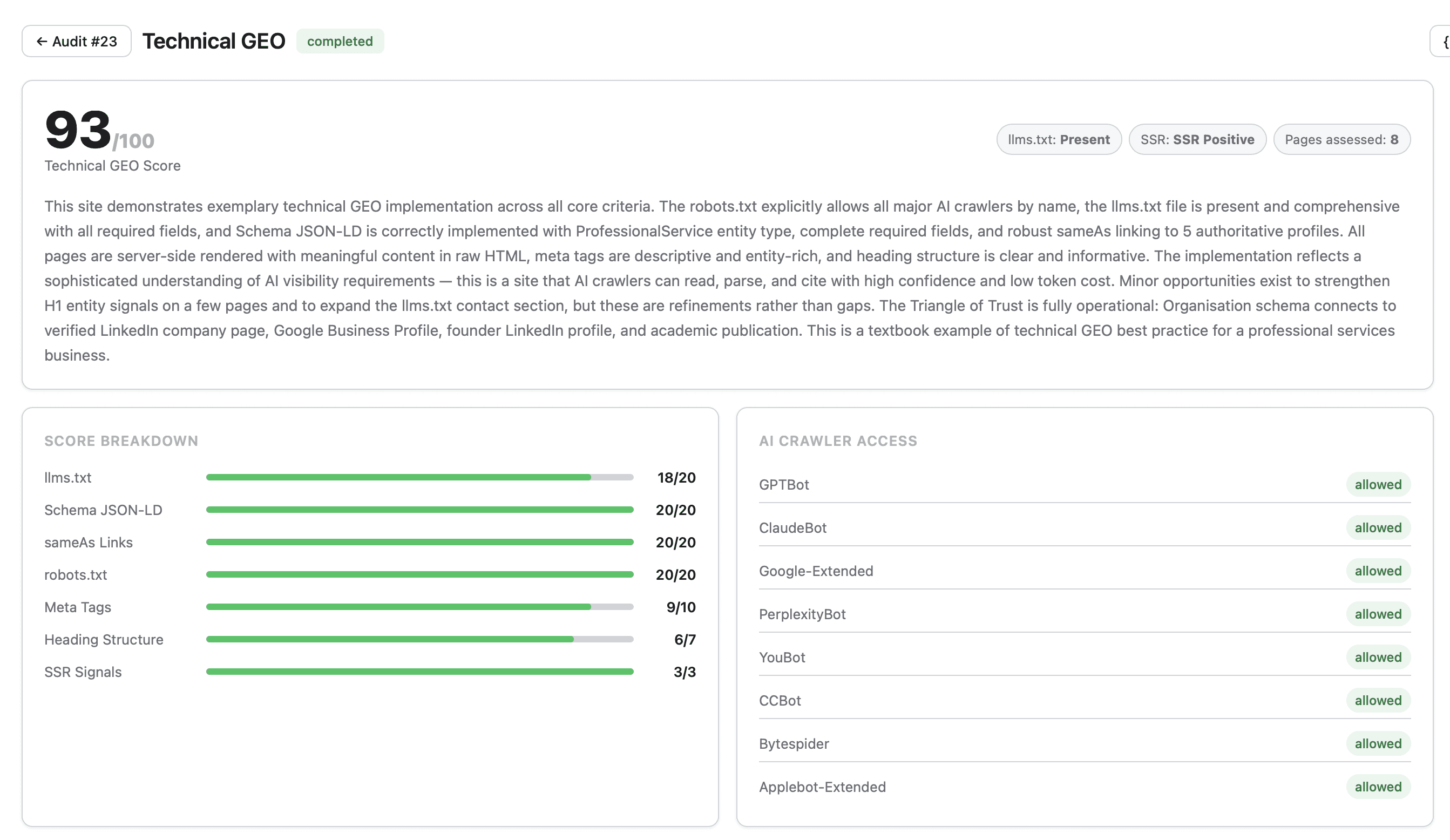
93/100 is a great score. There are a couple of gaps and AI would love me to share my phone number as a trust builder, but I'm good not doing that.
Next, onsite content and E-E-A-T.
Content GEO (E-E-A-T)
E-E-A-T. This is a framework used by AIs to evaluate a business. It stands for Expertise, Experience, Authority and Trustworthiness. You need to establish all four and there are best practices to do that.
Here's the before audit.
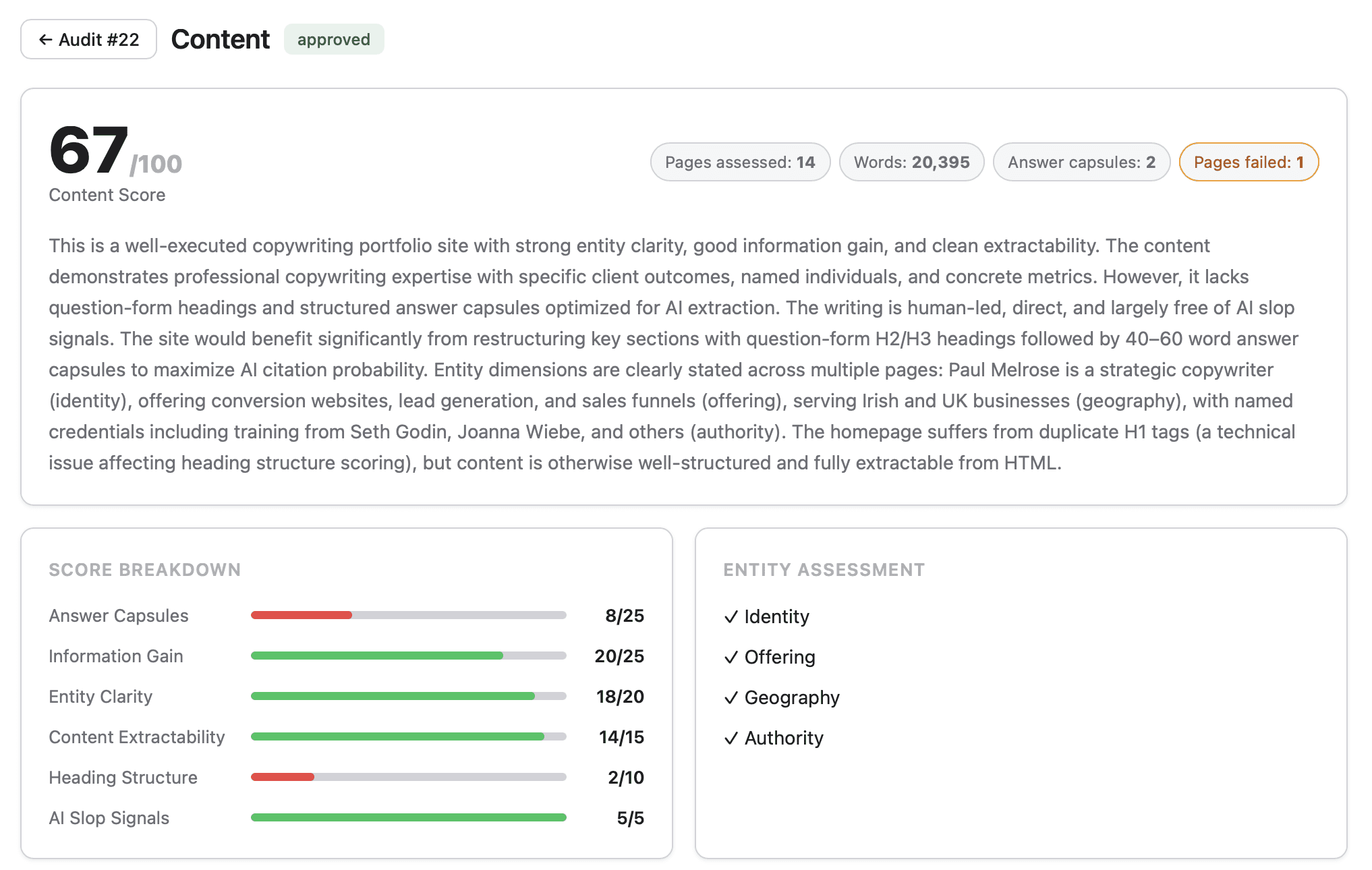
67/100 is a good score, and I wasn't that surprised.
I trained as a direct response copywriter, and my research indicated that direct response writing and structure is a good match for AI. The score breakdown shows I did well on providing it with information and clarity, and I had zero AI slop. But I was weak on something called Answer Capsules.
Answer capsules are short, structured question-and-answer blocks AI needs to extract data cleanly. I went to work on those and my H2 headers.
Here are the post-changes results:
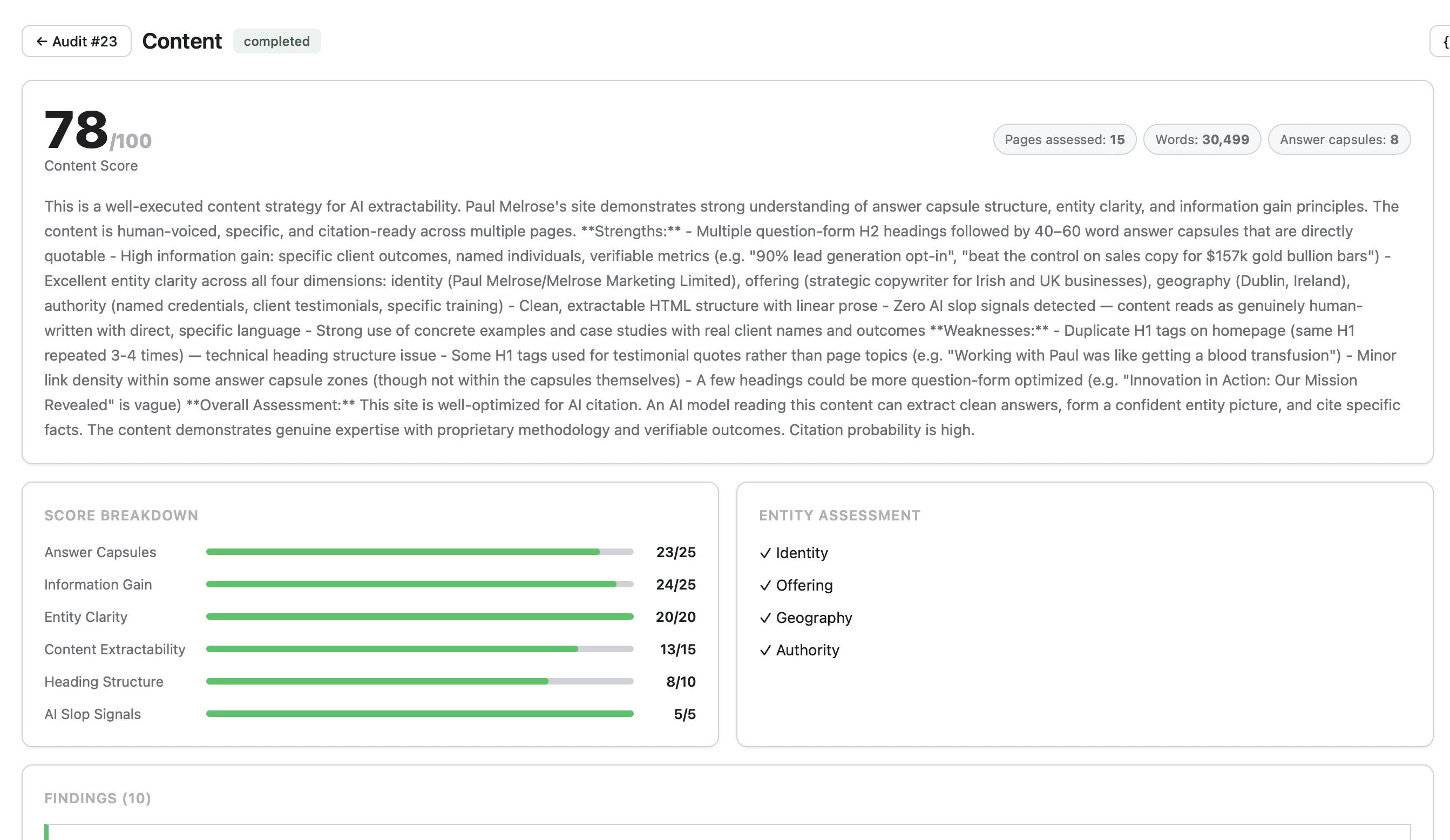
Not as dramatic a jump as in the technical section, but if you look at the score breakdown, you can see a big jump in areas where I was previously quite weak.
So what does all this work actually mean for my business, or yours, if you made similar changes?
What this does and doesn't mean
I managed to move my site from an average score of 50 to 86, but what does that mean in the real world? This is where we need to be cautious.
GEO is an emerging field. A lot of people are starting to make very big claims about it, but the research isn't mature enough to make some of those claims with confidence. We don't have that data yet. But there are some things we do know.
Foundational research, published by Princeton University at ACM KDD 2024, showed that structured content optimisation can improve AI visibility by up to 40% under controlled experimental conditions. That's indicative. But we also need to pay attention to where the research says the biggest gains can be made.
A 2025 follow-up study showed a systematic bias in AI search toward third-party authoritative sources over brand-owned content. That's an important point. Just as third-party validation is important for SEO, it matters for GEO. You can't rely on onsite changes alone.
I can also say this: my site now sends a clear, consistent, structured signal about what my business is, who it serves, and why it should be trusted. Before, AI systems had to do interpretive work, figuring out my identity and credibility from scattered signals. Now they don't.
A well-structured, GEO-optimised site removes noise and improves the signal that makes your business easier to understand, easier to verify, and easier to describe accurately. That's the precondition for AI visibility. Not a guarantee of it, but a necessary condition.
Now to the Ouch.
Strategy and Conclusion
There are two scores I haven't shared with you. My Online (off-site) Content score and my AI Visibility. My Online Content score is 38. My AI Visibility is 18.
Part of that is because my new business entity, paulmelrose.com, is only a month old. That will resolve itself in the next few months. But the real problem is strategic.
I have never had a strategy to build a visible online presence. My work to date has been referral-based, behind the scenes, deep projects with long timelines, and very little publishing. That is changing. Even referrals will check you out using AI, and strategic publishing is a must (volume-based content strategies that worked with SEO don't carry over to GEO).
And I'll leave you with this:
You are no longer marketing to just humans. Even if you have decided AI will never step inside the door of your business, your buyers will use it to find and vet you. We are now in the age of marketing to the machine.
I'm now offering GEO audits using the same audit and reporting tools I used on my own site.
Details here: https://www.paulmelrose.com/ai
Footnote: The App(s)
For those who are interested in such things:
The app I made is actually two applications: an audit app and a report generator. I separated the functions to keep the systems cleaner.
I used three LLMs with API integration. The stack is SQLite, Python servers and the usual frontend to run it through a browser. Both apps are local and pushed to Git. Development time was 2 weeks.
References
Princeton: GEO: Generative Engine Optimization" Aggarwal et al., Princeton University, published ACM KDD 2024: https://arxiv.org/abs/2311.09735
Chen et al. "Generative Engine Optimization: How to Dominate AI Search" — arXiv, September 2025: https://arxiv.org/abs/2509.08919
Details
Category
AI
Reading
6 minutes
Author

Paul Melrose
Paul is a Strategic Direct-Response Business Copywriter based in Dublin, Ireland.
Related News