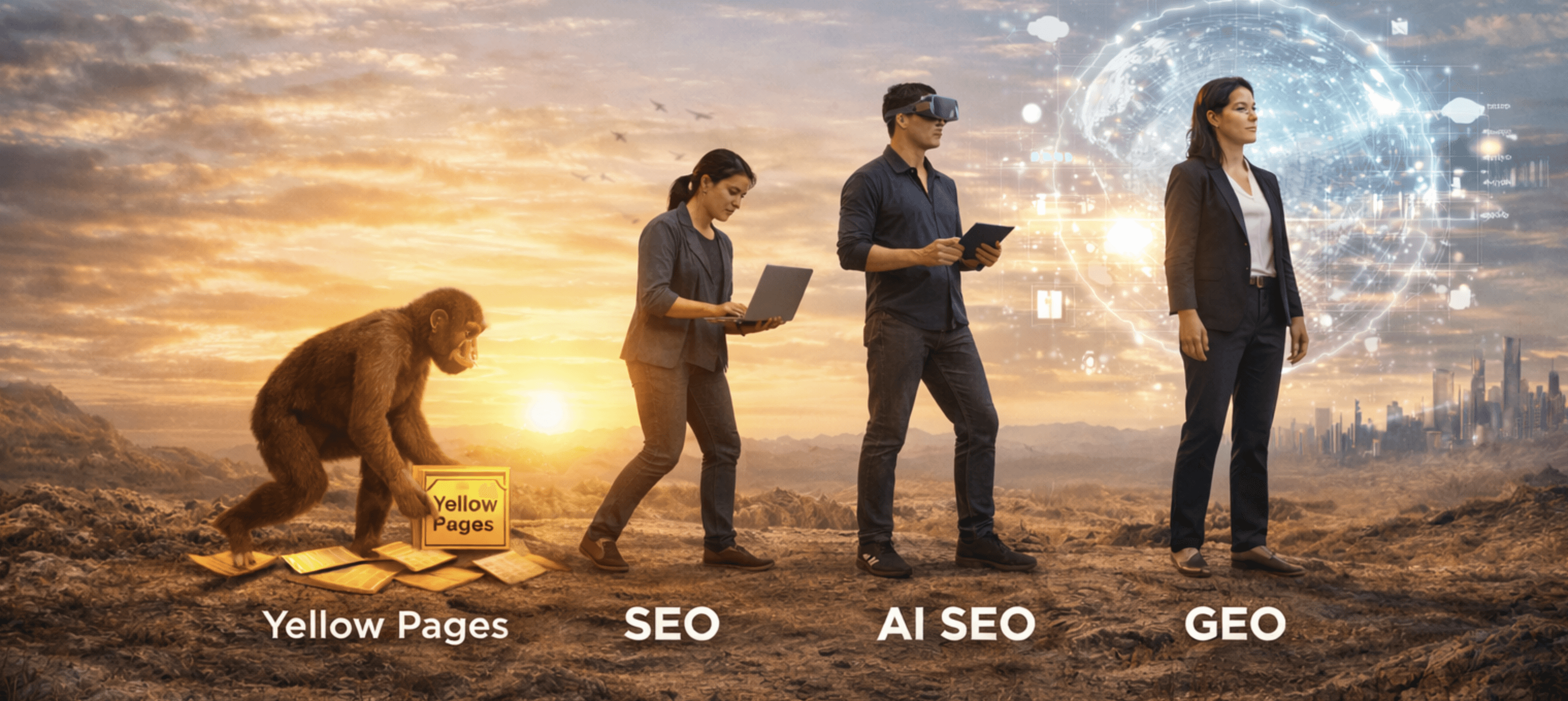
GEO Is Not AI SEO
Summary
Generative Engine Optimisation (GEO) is not AI Search Engine Optimisation (AI SEO). AI SEO optimises content so it can be extracted by AI systems. GEO optimises a business so it can be selected by them. The difference is Entity Resolution: whether an AI can confidently identify, verify, and cite your business as a trustworthy source. GEO is a strategic discipline. AI SEO is a content task.
What's the difference between GEO and AI SEO?
Generative Engine Optimisation is not AI Search Engine Optimisation. But you wouldn't necessarily know it from looking at what's being offered as GEO services.
The two are routinely conflated, and the conflation is costly, but also understandable. Both disciplines live at the intersection of content and AI. Both claim to improve your visibility in generative systems. But they operate at different layers, solve different problems, and most businesses are currently paying for the wrong one.
AI SEO optimises your content so it can be extracted by AI systems. GEO optimises your business so it can be selected by them. Extraction and selection are not the same problem.
That is not to say AI SEO is the wrong choice. In fact, it is a necessary part of GEO, but it is only a part of it.
We are going to look at SEO, AI SEO and GEO to see what the real differences are and why GEO is about much more than AI visibility.
What are SEO and AI SEO?
SEO is the practice of optimising pages to rank at the top of search results for queries your buyers are likely to use. It is a ranking system. You win when your page appears above competing pages for a given query. AI SEO extends that logic into generative systems, large language models such as ChatGPT or Claude.
It optimises content so it can be easily extracted, summarised, and cited by AI. Google's own guidance reflects the importance of accessibility, structure, and clarity (1). Before 2024, that was enough. Then something changed.
Where did GEO come from?
In 2024, a research paper from Princeton and Georgia Tech changed marketing (3). The researchers saw that search engines such as Google were starting to use AI to answer search questions directly, and that anyone relying on search engine traffic needed to move away from traditional SEO to a new paradigm they called Generative Engine Optimisation. They backed the claim with numbers:
"Through rigorous evaluation, we demonstrate that GEO can boost visibility by up to 40% in generative engine responses. Moreover, we show the efficacy of these strategies varies across domains, underscoring the need for domain-specific optimization methods. Our work opens a new frontier in information discovery systems, with profound implications for both developers of generative engines and content creators."
Everything they predicted has been confirmed. GEO is here, and it is our best answer to a world where AI is now part of the majority of human buying decisions. McKinsey reported in 2026 that 67% of UK consumers used at least one AI tool in the previous three months for researching and comparing purchases, a figure mirrored across the EU (8).
What makes GEO different from AI SEO?
AI SEO optimises content for AI ingestion, and just like traditional SEO, its guiding star is keywords. GEO does all of that, but it knows the prize is entities. Your business is an entity, and GEO optimises for its clarity and cross-platform coherence so that when an AI assembles an answer, it can confidently resolve who you are, what you do, and whether you are a trustworthy source. AI SEO solves the problem of extraction. GEO solves for resolution. Without that entity resolution, you are hitting very hard limits on what your content can do for your business.
How does AI SEO fall short?
AI SEO has a hard ceiling. You can structure, tag, and format your content until it is perfectly readable by every generative system in existence. But if the AI cannot resolve who you are as a coherent, verifiable entity, your content gets processed and discarded. You are visible at the page level but invisible at the entity level.
That gap is where most businesses are losing ground right now, and losing it quietly, because their content is still ranking in traditional search while becoming invisible inside AI systems. Your buyers are increasingly trusting what is inside those AI systems above what ranks on Google or Bing.
Why does GEO matter in 2026?
This is not a future problem. Search behaviour is shifting faster than most businesses have registered. Traditional search volume has already dropped 25% this year, and Gartner projects a 50% decline by 2028 as users move toward AI-first interfaces (5).
But volume decline is only half the story.
The traffic that AI generates is fundamentally different in quality. AI referral sessions convert at 14.2% compared to 2.8% for traditional organic search (6). That is not a marginal improvement. It means a smaller pool of AI-referred visitors outperforms a much larger pool of search-referred visitors on every metric that matters to revenue.
The correlation between ranking and selection, the foundational assumption SEO was built on, is breaking. The practical consequences are already being reported. Deepak Gupta discovered the gap firsthand:
"After scaling CIAM SaaS Platform, I've learned that ranking on Google isn't enough anymore. When we tested our top-ranking content on ChatGPT and Perplexity, we were invisible." (6)
The problem, as Gupta's team found, was that they had been optimising for Google's crawlers, not for AI extraction. Once they restructured their content around generative engine principles, direct AI referral traffic increased 340% over six months (6).
Ranking and being selected are no longer the same thing.
What is the strategic opportunity in GEO?
Most businesses responding to GEO are treating it as a content task. Restructure the pages. Add schema markup. Increase citation density. These are legitimate tactical responses, but they are not a strategy. A business that executes all of them without answering the entity question (what entity are we building, and what do we want to be the default answer for?) will improve its extractability and remain invisible at the level that matters.
GEO done properly is a positioning decision before it is a content decision. It requires a business to define the specific territory it intends to own in AI-generated responses, then build the evidentiary infrastructure to support that claim. That is a strategic conversation, not a technical one. The businesses that treat it as the latter are outsourcing their market position to their content team and hoping for the best.
Once the strategic question is answered (what do we want to be selected for, and by whom?), two mechanisms determine whether that strategy is visible to AI systems: Entity Resolution and Information Gain.
How do you optimise your business's entity?
Google organises entities into a Knowledge Graph and scores them using a framework called E-E-A-T: Experience, Expertise, Authority, and Trustworthiness. The stronger these signals, the more confidently an AI system will cite and recommend you. Entity resolution is the mechanism GEO is built around and E-E-A-T is the framework we use to do that. This is not limited to Google. E-E-A-T provides the signals all major LLMs use when deciding whether to include you in answers or recommendations.
You can do a lot of this lifting on your own site, but Google will give considerably more weight to cross-platform reinforcement and third-party signal confirmation. In other words, you cannot simply write your way there; you need a game plan. But for the parts where you are writing, there is something that will make the difference between AI dismissing you as noise or tagging you as a serious contributor to what your buyers have asked it to solve for: Information Gain.
How does Information Gain change how Google sees you?
Information Gain is the measurable difference between what your content contributes and what already exists.
Google's Patent US11386169B2 defines this formally: content that repeats what already exists is flagged for Information Redundancy (4).
The standard is close to academic: when you write an undergraduate thesis, known knowledge is sufficient. At doctoral level, you are expected to contribute something new to the field (2). AI systems are applying the same logic. Content that adds something genuinely new, derived from original research, Voice of Customer (VoC) data, or proprietary insight, carries evidentiary weight that AI systems are specifically selecting for. Content that restates what already exists does not.
Google's March 2026 Core Update made this explicit, prioritising content that adds new information over content that simply restates what already exists (7).
If you come to the table with new, credible data, Google will see you as unique and potentially valuable. If you turn up with the same old material it has seen a hundred times, it is an easy pass.
Both mechanisms, entity optimisation and Information Gain, are only as effective as the strategy they serve. Entity coherence without a defined position is noise. Information Gain without a clear territory to own is interesting content that leads nowhere.
What does a GEO strategy actually require?
A GEO strategy built around entity authority and Information Gain has four components, but they only work in sequence, starting with the strategic question rather than the tactical execution.
Define the territory. Not a broad category but a specific, ownable position, the context in which you intend to be the only logical answer. Not "financial advisor," but AI's default answer to "who understands how to manage wealth for High Net Worth Individuals resident in the UK."
Build entity coherence around that position. Identity, credentials, and positioning consistent across your site, LinkedIn, industry publications, and third-party mentions. Coherence is what allows AI systems to resolve you confidently rather than provisionally.
Create original content derived from real inputs. VoC research, proprietary data, documented case studies that contribute information AI systems have not already indexed. Commodity content does not build entities. It makes you fungible.
Treat E-E-A-T as a system, not a checklist. Experience documented, expertise demonstrated, authority built through co-occurrence with trusted sources, trust established through consistent schema and structured data.
The Shift
The businesses that own their categories in AI-generated responses are not the ones with the best-structured content. They are the ones who make a strategic decision about what they want to be selected for, and then build everything around that decision.
Most businesses are waiting for a technical fix. GEO does not have one. It has a strategic question: what do you want to be the default answer for?
Answer that first and everything else follows.
It is the difference between looking good in the mirror and getting invited to the stage.
____________
If you'd like to have a chat about using GEO as part of your lead-generation or sales, reach out and we can organise a chat. Click HERE.
You can find my GEO services HERE.
____________
Sources
(1) AI Features and Your Website | Google Search Central | Documentation, accessed on April 6, 2026, https://developers.google.com/search/docs/appearance/ai-features
(2) AI Visibility: How to Write Technical Content That AI Systems Will Cite | by Tao An | Medium, accessed on April 6, 2026, https://tao-hpu.medium.com/ai-visibility-how-to-write-technical-content-that-ai-systems-will-cite-36d8d331ec91
(3) GEO: Generative Engine Optimization | by Pranjal Aggarwal, Vishvak Murahari, et al. | Princeton University / KDD 2024, accessed on April 6, 2026, https://arxiv.org/abs/2311.09735
(4) Contextual estimation of information gain (Patent US11386169B2) | Google Patents, accessed on April 6, 2026, https://patents.google.com/patent/US11386169B2/en
(5) Gartner Predicts Traditional Search Volume Will Drop 50% by 2028 | Gartner Strategic Predictions, accessed on April 6, 2026, https://www.gartner.com/en/newsroom/press-releases/2026-strategic-predictions-ai-search
(6) The Complete Guide to Generative Engine Optimization: What B2B SaaS Companies Need to Know in 2026 | by Deepak Gupta | GrackerAI, accessed on April 6, 2026, https://www.guptadeepak.com/the-complete-guide-to-generative-engine-optimization-geo/
(7) Google Search's Core Updates and Your Website | Google Search Central | Documentation, accessed on April 6, 2026, https://developers.google.com/search/updates/core-updates
(8) An update on EU consumer sentiment: The uptake of AI shopping tools | McKinsey | Accessed on April 7, 2026, https://www.mckinsey.com/industries/consumer-packaged-goods/our-insights/an-update-on-european-consumer-sentiment
The main image used in the banner for this post was AI-generated.
Details
Category
GEO
Reading
9 minutes
Author

Paul Melrose
Paul is a Strategic Direct-Response Business Copywriter and Consultant based in Dublin, Ireland.
More articles