Compliance Obligations for Business Websites : A Guide for Irish SMEs
What does an Irish SME need to know and include on their website to be compliant with Irish and EU law?
Before we get into the article, I need to cover myself legally:
Disclaimer
While I’m obsessive about compliance for my own business (Melrose Marketing Limited) and I write websites as part of my professional work, I’m a marketer, not a solicitor. This article is not legal advice or a substitute for it. Think of it as a briefing paper to get you orientated. And since laws do change, I’d always suggest running your final site setup by a qualified legal expert to make sure you’re 100% covered.
Okay, now the article.
Why is Compliance for Irish Business Websites More Important Than You May Think?
The obvious answer to why compliance matters might appear to be not wanting to be fined for violations, but there are two more reasons.
A lot of these regulations protect us as well as our buyers and potential buyers. They make our marketplace safer for our buyers and that's good for business.
The second is how AI will view us when we do the things it knows we should, like conforming to data transparency requirements. AI sees these things.
The Three Tiers of Compliance
To make it easier to prioritise what you need to do to keep your site compliant with Irish and EU law, I've divided this article into three tiers:
Tier One focuses on Identity. These are required details you can add in a few minutes
Tier Two is the next level up in terms of the work involved. Some changes will be quick and easy, some will require some prep work.
Tier Three covers newer requirements such as how you use AI, eco-claims and accessibility.
Tier One: Static Legal Identity
What do you need to disclose on an Irish business website about you and your business?
The Companies Act 2014 (Section 151) dictates the information that Irish companies must disclose in their communications and the legal requirements for electronic commerce. Here's what the Companies Act says you need on your website:
Company Name and Legal Form: The full name and type (e.g., Limited, DAC).
Registered Office Address: The physical address of the registered office.
Company Registration Number: The CRO number.
Place of Registration: (e.g., "Registered in Ireland").
Share Capital Reference: If you choose to mention capital, it must be the issued share capital that is paid up.
There's also the European Communities Directive 2000/31/EC Regulations 2003. It says you must include:
email address for direct communication.
Your VAT number if you're registered.
If you're a regulated professional, the body that regulates you.
To align with standard Irish business letter requirements, many recommend listing your directors' names on your site. If any directors are not Irish, including their nationality is the safest way to ensure you're fully covered.
You can place all of this on your Terms page, but as a trust builder, carry your company's legal name, your CRO number and place of registration in your footer.
And lastly, if a company is winding up, that must be stated on the site.
Tier Two: Trust and Redress
What do you need to know about handling data and explaining dispute resolution?
These cover how you treat data and how you handle the process of communicating with potential buyers.
GDPR & Privacy: If you use cookies that track any data that can be tied to a person, you need a compliant Privacy Policy and a Cookie Banner. Where "Accept All" and "Reject All" buttons have equal prominence (no "dark patterns" hiding the opt-out). The easiest way to handle this is to design for privacy. I don't track personal data on my site, so I don't need a cookie banner. But I still need a privacy page because I use my site as a way to communicate with potential clients. If you have cookies, you need a Cookies Policy page.
Testimonial Transparency: You must be able to prove your reviews are real if challenged. This matters if you are linking to review sites like Trustpilot or Yelp, where reviews might be fake. Under the Consumer Rights Act 2022, displaying fake reviews or failing to justify verification steps is prohibited.
Distance Contract Disclosure: Most purchases have a legal cooling-off period, unless there is a waiver for beginning services earlier. You must clearly state the 14-day cooling-off period either on your site if you are selling from your site, or in documentation before a purchase (and you should have a way to prove you did that). If you don't inform your buyer of their right to cancel, the cooling-off period can legally extend up to 12 months.
Pricing: For B2C, you must provide the total cost (including VAT). For B2B, you can provide ex. VAT pricing, but you should clearly state that all prices on your site are exclusive of VAT. Your footer is a good place for that.
ODR Link Removal: In the past, you needed a mandatory link to the Online Dispute Resolution (ODR) platform. This platform was officially discontinued by Regulation (EU) 2024/3228, and complaints were stopped as of March 2025.
Tier Three: AI and Green Regulations
These are the newest Modern-Era laws that most Irish businesses are still catching up on. Let's dive in with accessibility.
How Does the European Accessibility Act Affect Irish Business Websites?
The European Accessibility Act became law in Ireland on 28 June 2025. For large businesses, it introduced mandatory compliance for accessibility standards and the requirement for an Accessibility Statement.
Micro-Enterprises (less than 10 employees and under €2million in turnover), are exempt. But...
Even if you're exempt from the new reporting rules, making your site accessible is just good business. Plus, under the Equal Status Act, you want to ensure no customer is effectively 'locked out' of your services due to a digital barrier.
Here's a quick check you can run on your site:
Open your site in Chrome (Safari disallows this unless you change a setting). Hit TAB. Hit it again. Each time you hit TAB, it should jump to a new element on your site.
When it lands on a menu item, press ENTER. If it takes you to that page, then it's looking good. If not, you have an accessibility problem. This is not a comprehensive test by any means, but it's a very quick way to see if you have at least some of your bases covered.
What Do Irish Businesses Need to Show On Their Websites If They Use AI?
AI transparency is a big issue for your legal compliance and buyer trust. The EU AI Act is the legislation that covers the legal side of that. The act says that from August 2, 2026:
If you use AI chatbots or any AI content (deepfakes/AI-generated video/audio), you must clearly label them at the first point of interaction.
If you publish AI text, you must also declare it unless a human has 'meaningfully' changed or edited the text before publication. That means you can use AI as part of your writing process as long as you are the main driver, you have overseen the final text and have significantly contributed to the final output.
What Can Irish Businesses Say on Their Sites About Their Green Credentials?
If you haven't heard about 'greenwashing', you have now. It's the practice of making eco claims that are, at best, lip service. The EU thinks that dishonest, and they're right. New legislation, effective from September 27, 2026, bans claims such as 'eco-friendly' or 'climate neutral' unless you have third-party certification.
How Does The Digital Services Act Affect Irish Business Sites?
The DSA only affects a small number of sites and is concerned with transparency.
The "Point of Contact": If you run a site where users can post things (like a forum, a review section, or a community space), you must provide an easy way for people and Irish authorities to contact you. Usually, this means having a dedicated email address in your Terms page.
The "Marketplace" Rule: If you run a site where other people sell their products (like a mini Etsy or a local vendor directory), you are now legally responsible for knowing who they are. You can’t let them sell on your site until you’ve verified their name and contact details. This is to stop "ghost" sellers from scamming people.
Ad Transparency: If you run ads on your site, you have to make it crystal clear to the visitor who is paying for the ad and why they are seeing it.
Wrapping up
Is there an upside to compliance?
Compliance is a cost, both in time and money. But there is a massive upside: it sends a clear, high-contrast trust signal to your customers, and to the AI agents they’ll soon be using to find and vet you. If your site makes it easy to see who you are (all that company data in Tier One), then it's easier for the AI to trust you. And one final benefit. These laws are a direct response to shoddy marketing, like fake reviews and 'gotcha' pricing. By getting it right, you're not just avoiding a fine; you're separating yourself from the noise.
Referenced Legislation
Companies Act 2014, Section 151. Focus: Statutory disclosures for business letters and websites including legal name, CRO number, and registered address. Link: https://www.irishstatutebook.ie/eli/2014/act/38/section/151/enacted/en/html
S.I. No. 49/2007 — European Communities (Companies) (Amendment) Regulations 2007. Focus: The regulation extending paper letterhead disclosure requirements, including directors' names and nationalities, to company websites. Link: https://www.irishstatutebook.ie/eli/2007/si/49/made/en/print
S.I. No. 68/2003 — European Communities (Directive 2000/31/EC) Regulations 2003. Focus: E-commerce requirements for providing a geographic address and a direct, effective email address. Link: https://www.irishstatutebook.ie/eli/2003/si/68/made/en/print
Consumer Rights Act 2022. Focus: Transparency for online reviews, digital services, price indications, and the 14-day statutory cooling-off period. Link: https://www.irishstatutebook.ie/eli/2022/act/37/enacted/en/html
Regulation (EU) 2016/679 (General Data Protection Regulation - GDPR). Focus: The core framework for data processing, privacy policies, and user data rights. Link: https://eur-lex.europa.eu/legal-content/EN/TXT/?uri=CELEX:32016R0679
S.I. No. 336/2011 — European Communities (Electronic Communications Networks and Services) (Privacy and Electronic Communications) Regulations 2011. Focus: Regulations governing cookie consent banners and electronic direct marketing. Link: https://www.irishstatutebook.ie/eli/2011/si/336/made/en/print
S.I. No. 597/2022 — European Union (Requirements to Indicate Product Prices) (Amendment) Regulations 2022. Focus: The "30-day rule" requiring display of the lowest prior price during sales or promotions. Link: https://www.irishstatutebook.ie/eli/2022/si/597/made/en/print
S.I. No. 636/2023 — European Union (Accessibility Requirements of Products and Services) Regulations 2023. Focus: Transposition of the European Accessibility Act (EAA) regarding website accessibility standards. Link: https://www.irishstatutebook.ie/eli/2023/si/636/made/en/print
Regulation (EU) 2024/1689 (Artificial Intelligence Act). Focus: Transparency and mandatory labeling for AI-generated content, synthetic media, and chatbots. Link: https://eur-lex.europa.eu/legal-content/EN/TXT/?uri=CELEX:32024R1689
Directive (EU) 2024/825 (Green Claims). Focus: Prohibition of generic environmental claims like "eco-friendly" without verified environmental performance. Link: https://eur-lex.europa.eu/legal-content/EN/TXT/?uri=CELEX:32024L0825
Regulation (EU) 2022/2065 (Digital Services Act - DSA). Focus: Intermediary responsibilities and the requirement for a designated single point of contact for authorities. Link: https://eur-lex.europa.eu/legal-content/EN/TXT/?uri=CELEX:32022R2065
Regulation (EU) 2024/3228 (ODR Repeal). Focus: Legislation officially discontinuing the Online Dispute Resolution (ODR) platform and associated link requirements. Link: https://eur-lex.europa.eu/legal-content/EN/TXT/?uri=CELEX:32024R3228
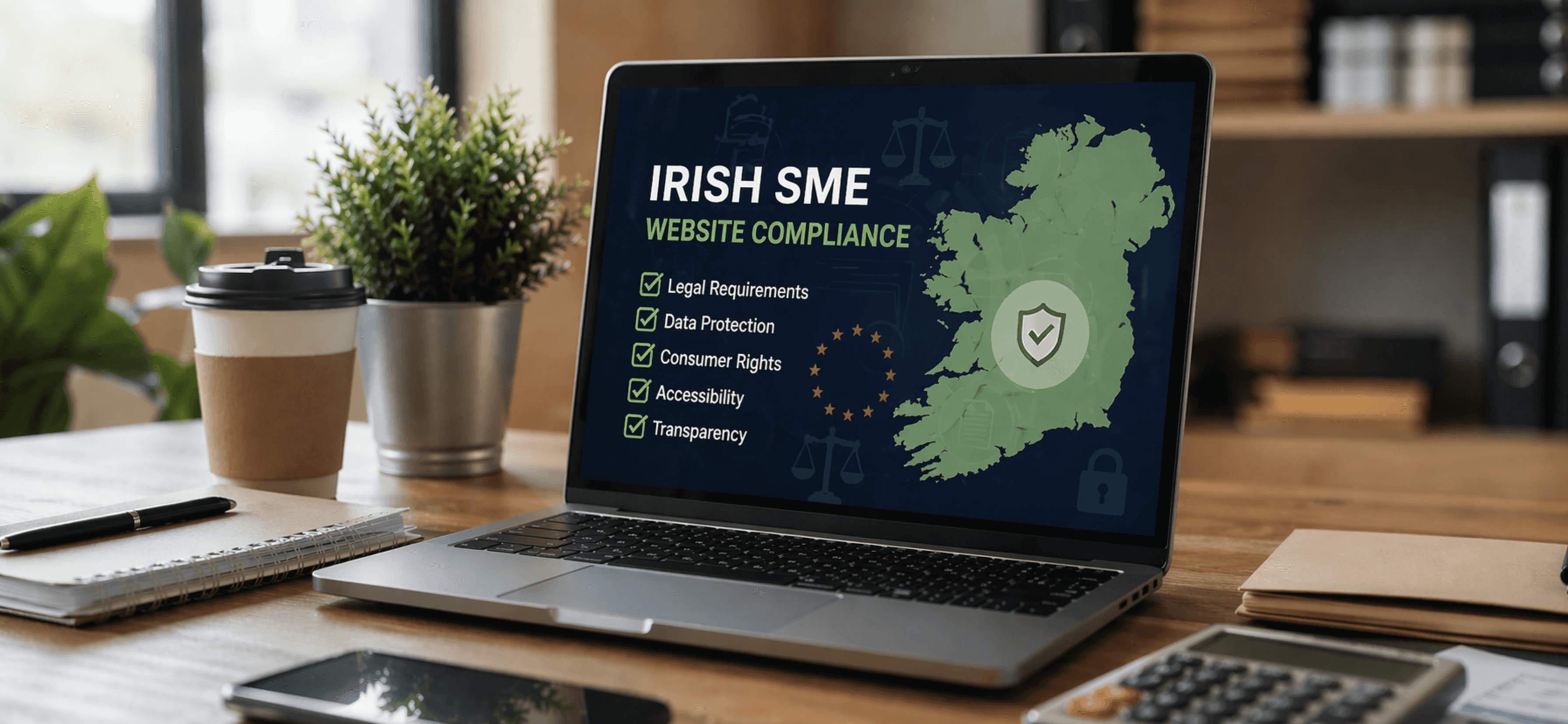
The main image used in the banner for this post was AI-generated.
Details
Category
Marketing
Reading
10 minutes
Author

Paul Melrose
Paul is a Strategic Direct-Response Business Copywriter and Consultant based in Dublin, Ireland.
More articles