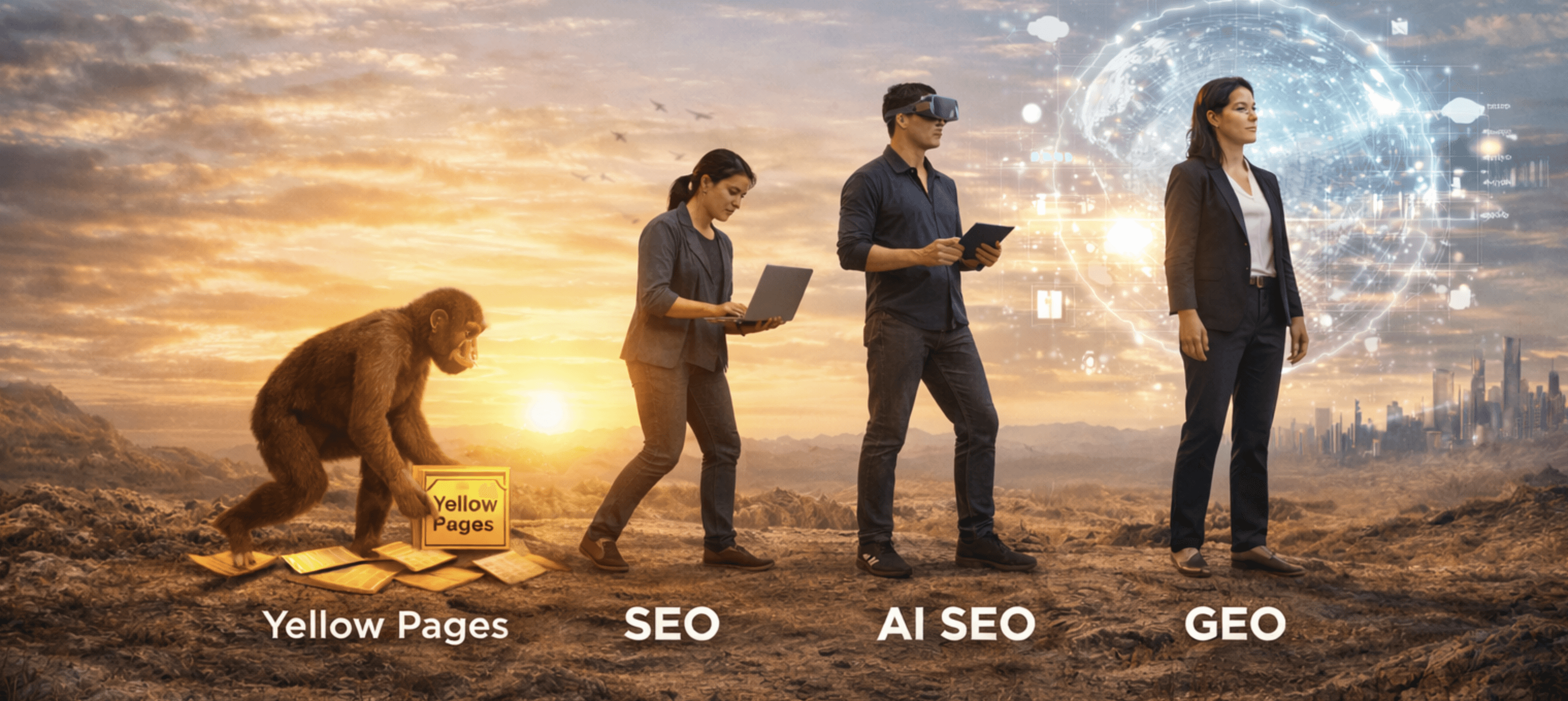
Can You Use AI As Your Marketer?
Should you use AI in your business? If so, how and where? Is it even worth it? And can you use it as your marketer? And what's the legal risk of using AI to write for you?

Making good AI decisions
There’s a lot of hype out there.
HubSpot executives are posting videos on how to replace your marketing team in 30 minutes, and it feels like AI CEOs are telling us every three months that in three months, AI will be doing everything.
It’s easy to feel like there’s a gold rush and you’re a fool if you don’t start digging. But we've been here before. This is at least the third time since the 1950s that AI scientists have claimed we are one the cusp of genuine human-like intelligence.
Still, AI is here, it can do work for us, and it’s at least worth considering.
Rather than writing about what's happening with AI right now, this article is about how to make good decisions around AI use, and I’ll answer these five questions:
1. Should you use AI?
2. If so, where and for what?
3. Is it worth it?
4. Can AI be your marketer?
5. What is the legal risk you run if you let AI write for you?
Should you even use AI?
AI is seductive. The first time you use it, it feels like magic. But…
Gartner* (big name in business research) is telling us that over 40% of CEOs are going to pull the plug on agentic AI projects. A 2025 academic study** reports that AI agents failed to complete real-world freelance tasks to a satisfactory standard 96% of the time. (And some of the failures were spectacularly bad.)
Then there’s the truth problem.
It will tell you something false with exactly the same confidence it tells you something true. And it can't tell the difference. And even if you point it out, it will often stand its ground.
So, is it even safe to use? Especially if you are not an expert in it?
The answer is a qualified yes, as long as you follow some basic principles and are very judicious about how and where you use it.
Let’s begin with some guiding principles.
The Expert Principle
If you can't make a judgment call on AI output, you're outsourcing your judgment to a machine that has none. You need to be the domain expert.
The Competency Principle
Don’t wing it. “Just ask GPT” is a bad idea.If you’re hoping AI can make a contribution to any part of your business, you need a base level of understanding.
Even if you’re outsourcing, you need to know the basics. You can learn enough to use a model like Gemini or ChatGPT in an afternoon with a Coursera course.
The Compliance Principle
(Less of a principle than an obligation.) If you are using AI for business and handing it customer or client data, there are legal obligations that come with that. These are covered in the EU Artificial Intelligence Act.
Better, Not Faster
This is my approach to AI, and you can agree or disagree.
AI’s current value isn't efficiencies or cost savings. Its value is as a lever that increases the value of our decision-making. Good decisions are the most valuable thing in any business.
When and where should you use AI?
To help you make a decision about using AI, I’ve made this decision quadrant.
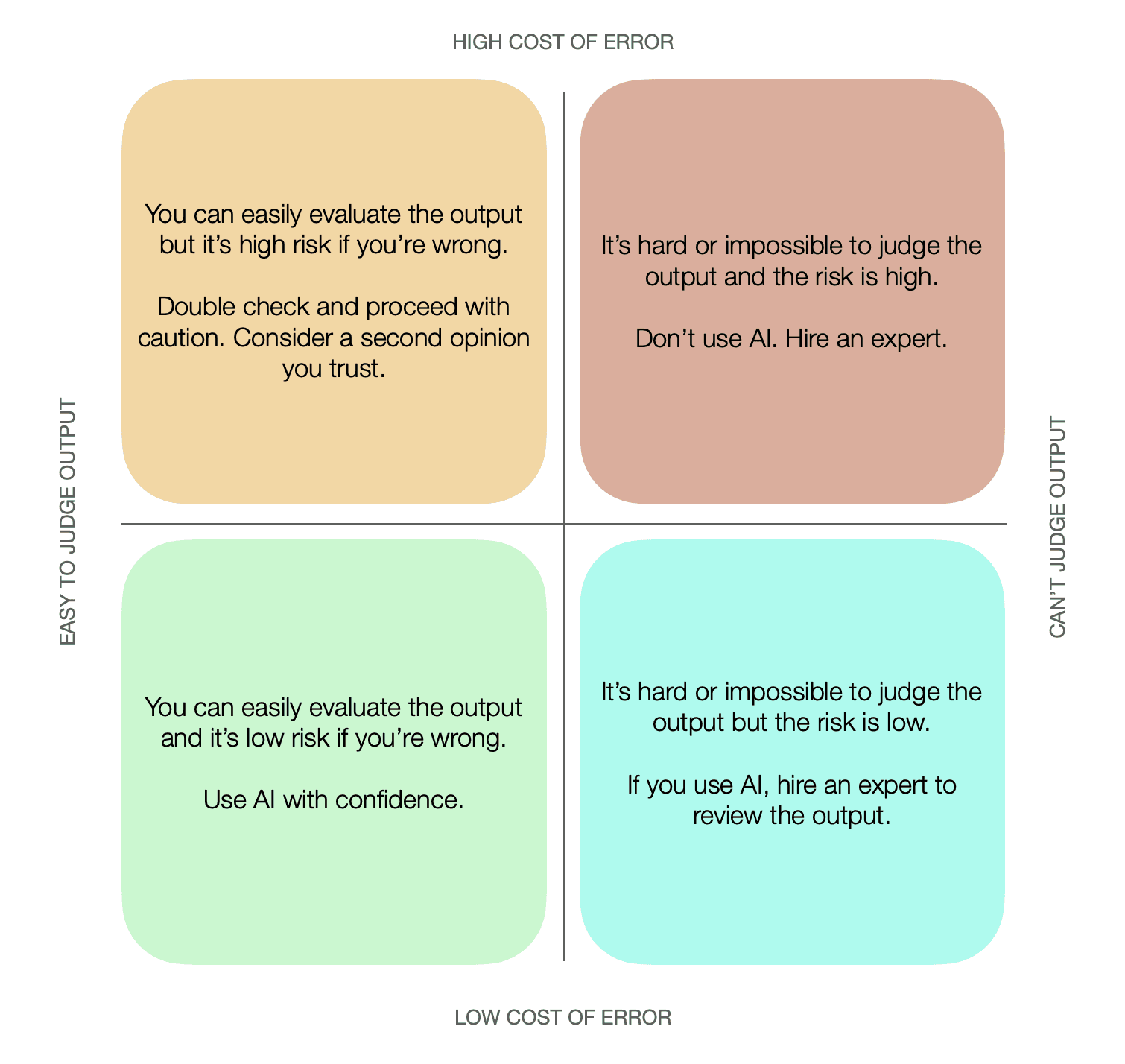
The quadrant has two axis. One for how well you can evaluate the output your AI gives you, and one for how damaging it would be to your business if the output were bad.
If the AI output is easy to evaluate and the risk of that evaluation being wrong is low, that's the bottom left box. Using AI to generate an image for an article, like this one, for example.
If the evaluation is difficult or impossible for you to carry out, and the impact of being wrong is high, then it's the top right box. That might be writing a contract.
Is it worth it?
If your needs are simple, such as rewriting your emails or polishing your blogs, then fire away. But if you want AI to have a deeper impact, then it can get expensive.
If you have a team and want to use it as part of your daily work, you are looking at spending up €200 a month per person for access to a model like ChatGPT or Claude. Then there’s ongoing training for each person. You should also assign or hire someone who will act as your AI lead.
There are other costs too, like governance and a productivity hit as the learning curve starts. And it mightn’t work.
Given all that, how do you make that kind of decision?
Start with, do we need it? If you believe yes (and this is where the decision quadrant above suggests you at least ask an expert to help you with this), then start small and stack the deck in favour of it working.
Pick one area or project that, if it works, would be a big win. Pick something with as few moving parts as possible. Attach success metrics. Set a realistic budget for time and money. Then run with that.
Can AI be your marketer?
I'm a little biased here, so I asked Claude (4.6) to answer that instead:
“No. But it can make you a better one.Marketing is judgment — knowing which message lands with which buyer at which moment. AI has none of that. It has patterns, probabilities, and plausible-sounding sentences.
What AI can do is handle the heavy lifting once you know what you want to say. Draft, iterate, reformat, repurpose. Used well, it frees you to spend more time on the thinking that drives revenue.
But here's the trap. AI copy looks like marketing. It hits the expected notes. A business owner reads it and thinks: That's pretty good. It might be. Or it might be generic, tonally wrong, and quietly failing to convert anyone. You won't necessarily know which.
AI is not your marketer. At best, it's a capable assistant that needs a good brief, a strong editor, and someone who knows the difference between copy that sounds right and copy that sells.”
The Legal Risk
If you use AI to write for you, there is a risk it is recycling someone’s copyrighted content and that could lead to legal issues and all the cost and stress that goes with it.
Even if it doesn’t, you don’t own what it writes for you as AI content can’t be copyright protected. That means anyone can use your AI-generated marketing and you have no way to stop them.
If you claim copyright on AI writing, you're in a legal no-man's land. If someone sells you AI copy and says it was written by a person, that's possibly fraud.
So, you get hit-or-miss copy, which might land you in court, and your competitors can use it if it's any good.
Conclusion
AI is not a replacement tool
For important work that involves significant decisions, ask yourself this: Can you do it well without AI?
If the answer is no, don’t use AI to fill that gap. It will bite you hard and you won’t even know till the cost is written in your balance sheet.
If you want to use it for your marketing, then become good at marketing or hire someone who is.
AI will enhance good decision-making and punish bad decision-making. It can help good marketers do better work, but can harm business that don't have marketing expertise. In other words, it will amplify your strengths and weaknesses, making good better and bad worse.
If you want a deep-dive into the history of AI, Artificial Intelligence: A Guide for Thinking Humans by Melanie Mitchell is a good read.
If you would like to talk about AI in your marketing, reach out and we can arrange that.
___________________________
Sources:
* Gartner article: https://www.gartner.com/en/newsroom/press-releases/2025-06-25-gartner-predicts-over-40-percent-of-agentic-ai-projects-will-be-canceled-by-end-of-2027
** 96% failure paper: https://arxiv.org/html/2510.26787v1
Details
Category
AI
Reading
6 Min
Author

Paul Melrose
Paul Melrose is a Strategic Direct Response Copywriter and marketer based in Dublin, Ireland.
More articles