
What Can Irish and UK Business Coaches Learn from 100 Forbes Coaches' Marketing?
How well do elite coaches market themselves? What can Irish and UK business coaches learn from how they communicate their position, value and their offer?

An Analysis of 100 Forbes Council Coaches' Marketing
Summary
In an analysis of 100 Forbes Coaches Council members, I found that 97% make it harder than necessary for potential clients to see and understand their value, and only 3% demonstrate consistent, well-aligned marketing. Here is what the data shows, and what it means for coaches in Ireland and the UK.
Report Summary and Headline Findings
In Q2, 2025, I carried out a detailed analysis of 100 Forbes Coaches Council members. I looked at 18 different data points for each and scored them across six categories. Here are the main findings:
Overall, 97% of coaches under-communicated or plain hid their value from their ideal clients
Coaches were strongest when presenting their offer, with 75% scoring well here
For website About copy, 60% scored well, but that dropped to 47% for their LinkedIn profile
The majority, 57%, did well on niching
On Readability, 33% had easy-to-read sites and 13% were difficult. The rest were moderate
A full 29% didn't state they were a coach in the top section of their LinkedIn Profile
For Value Propositions, only 13% did well on LinkedIn and 12% on their sites. Nearly a third scored zero on both. That's a major problem
Value proposition alignment across platforms was passed by only 12% of coaches — a big red flag for fragmented marketing
The rest of this article will look at exactly where coaches are doing well and failing in their value communication, and we will look at how you can learn from these successes and failures for your own marketing.
Why I Carried Out This Research
In 2025, I was on retainer for a significant project in the coaching area. To support that work, I needed a deep understanding of how business coaches were actually marketing themselves.
I wanted to answer four specific questions:
Do elite coaches actually market well, or do they just have impressive credentials?
How clearly do they state their value proposition?
Is their marketing consistent across their website and LinkedIn?
Where are the gaps a better-marketed coach could exploit?
The choice of Forbes Coaches Council was deliberate.
Membership isn't free and it requires an application, a fee, and a level of professional standing. That signals something important: these are coaches who have already demonstrated a willingness to invest in their visibility. They are not coaches who ignore marketing. They take it seriously enough to pay for a platform.
That makes them a credible benchmark. If these coaches have marketing gaps, the average coach most likely has them, and they are probably wider and deeper.
What I Assessed
To get that insight, I reviewed the online marketing of 100 coaches.
I chose coaches who were both current Forbes Coaches Council members and active on LinkedIn. That's a double qualifier for being serious about their business and actively promoting it. It's also a pretty good benchmark to judge yourself against.
While Forbes Council doesn't publish how many members it has, estimates range from 1,500 to 2,500. If we go with 2,500, our sample of 100 is large enough to give us 95% confidence in our findings with a margin of error of ±9.5%.
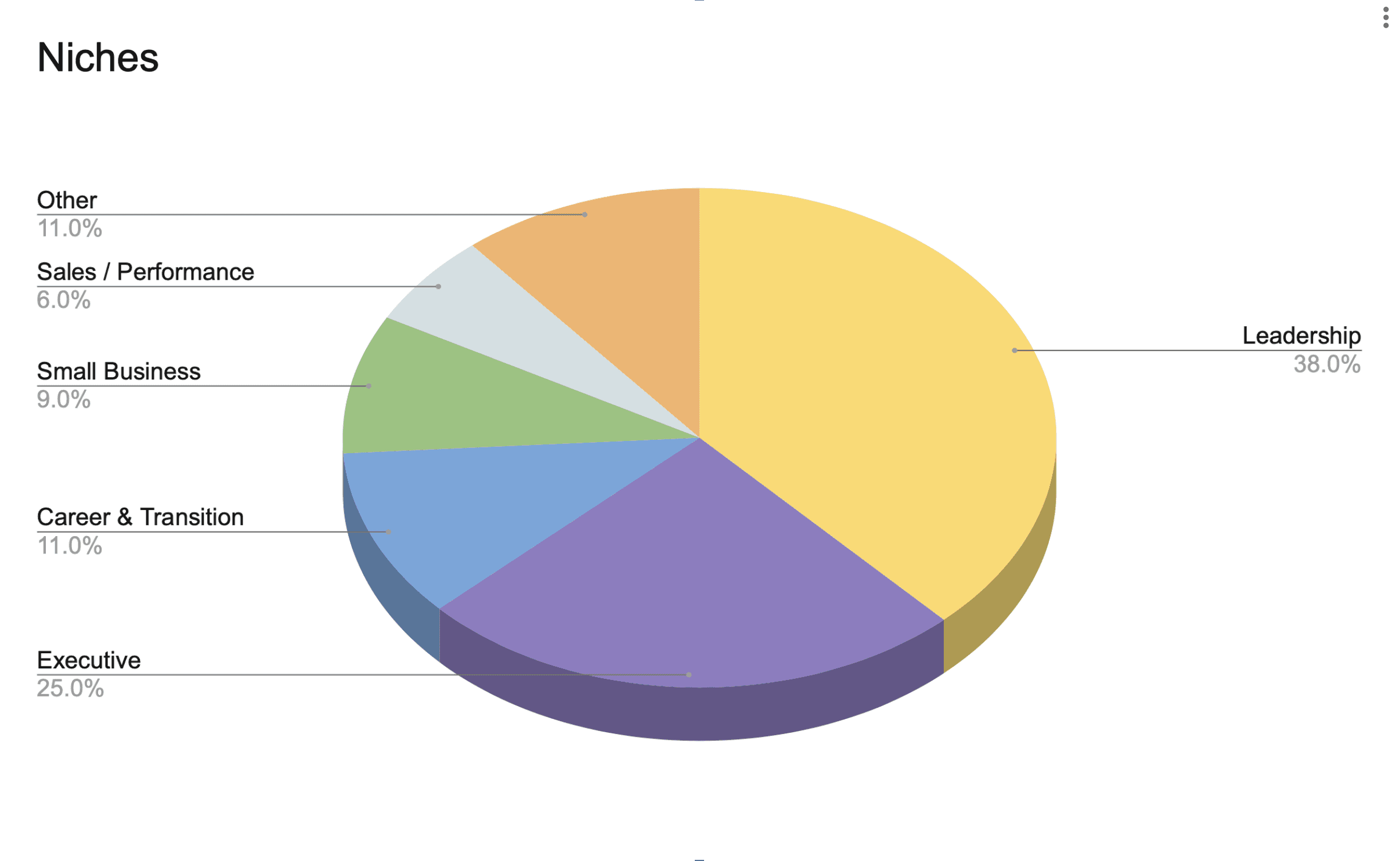
Niches of the 100 coaches reviewed (chart below table with same information):
Niche | Share |
|---|---|
Leadership | 38% |
Executive | 25% |
Career & Transition | 11% |
Other | 11% |
Small Business | 9% |
Sales / Performance | 6% |
I looked at how coaches performed in these areas:
Professional Profile (LinkedIn)
Niching
Value Propositions (site and LinkedIn)
Value Proposition Alignment
Lead Magnets (site and LinkedIn)
Offer Strength
Readability
Altogether, I collected data across 18 points including how well coaches did at consistency across different metrics.
One important note before the findings: there's a degree of professional subjectivity in this report. I could only assess what was public-facing and I have no internal metrics on any coaches.
These are accomplished individuals with excellent credentials and often well-established businesses. But they are not expert marketers. And because most coaches do quite a bit of DIY marketing and write their own copy, it's unrealistic to expect them to score highly against professional marketing.
That is precisely the opportunity.
What is The Most Basic Mistake Business Coaches Make on LinkedIn?
What is the simplest thing you can do on your LinkedIn profile to help clients self-select to learn more about you?
Tell them you're a coach.
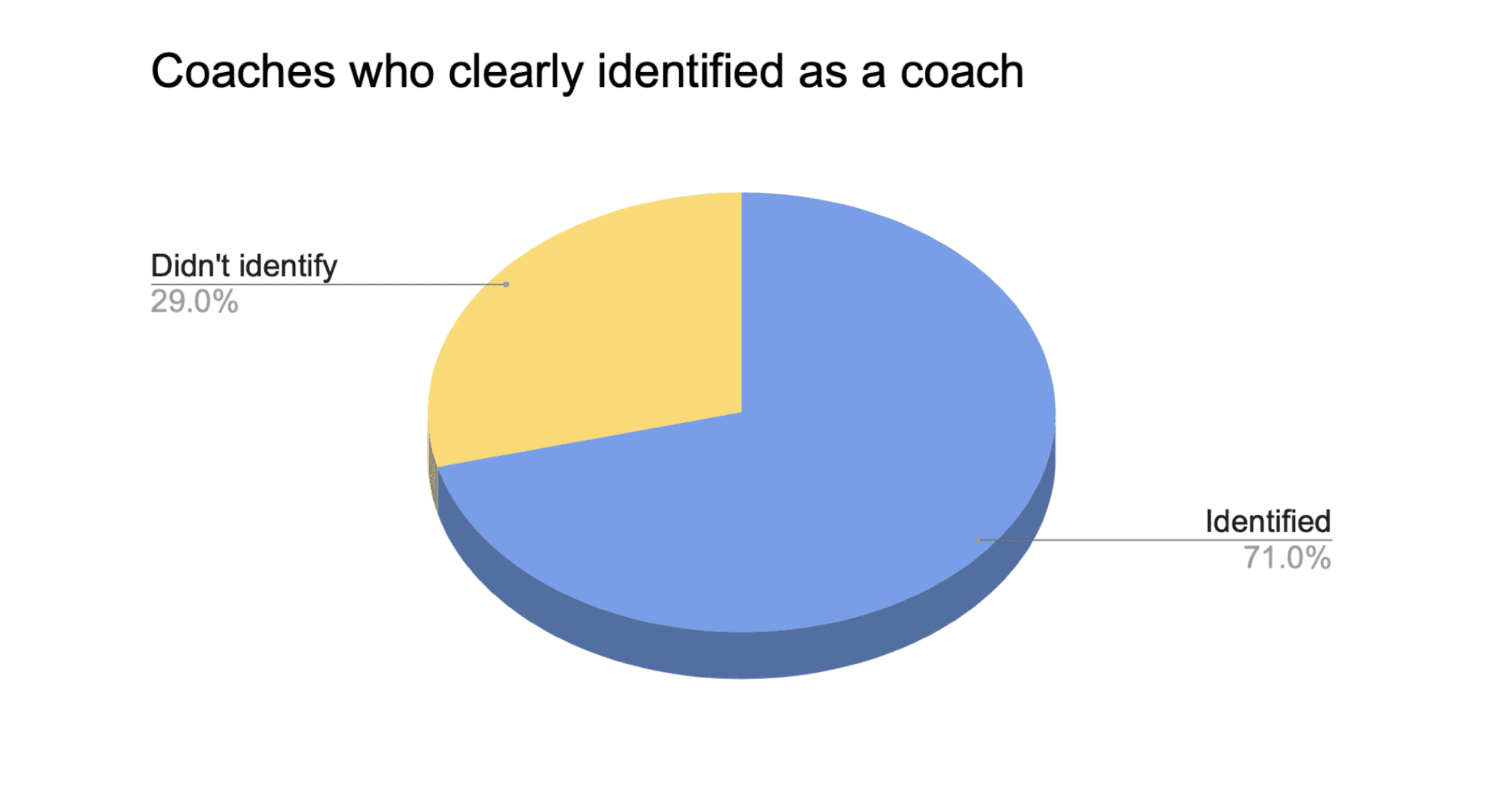
I looked at every coach's LinkedIn profile to see if they clearly stated they were a coach, in either the banner image or the profile summary underneath their name.
Result: 29% didn't identify as a coach in their LinkedIn header area. 71% did.
This is not a complex messaging failure. It is a basic one. And it is the kind of gap that a well-structured LinkedIn profile closes in an afternoon.
How Well Do Elite Business Coaches Define Their Niche?
When a potential client lands on your site, always let your ideal clients know you are specifically and exclusively for them. You do that by articulating your niche. That might be geographical, age/gender, professional level, by sector, or a mix. However you do it, it should be clear to any site visitor that you serve a well-defined cohort.
Findings: Over half the coaches, 65%, scored well. But about a third (35%) could make big improvements.
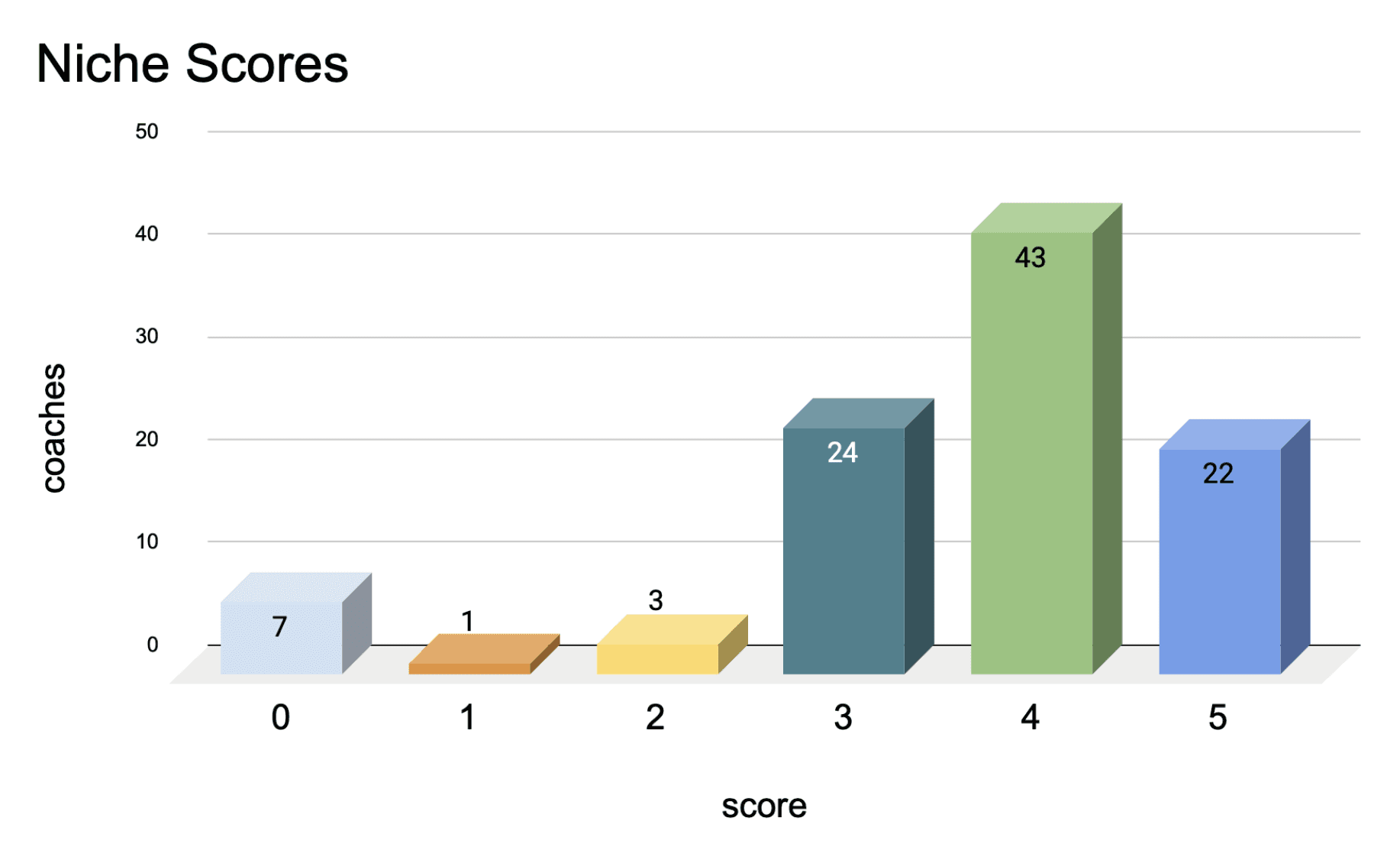
Here is the scoring rubric for those numbers:
Score | Label | Description | Example phrases |
|---|---|---|---|
1 | Niche absent | No audience defined. Uses generic or universal terms like "people," "clients," "leaders." No specific role, industry, or transformation named. | "Helping clients live with purpose" / "Supporting others in their growth" |
2 | Implied niche | Some hints at who it's for (e.g., "teams," "founders") but not explicitly stated. No specific pain point or context. | "Empowering professionals to succeed" / "Helping teams grow with intention" |
3 | General niche | Audience is named, but broad (e.g., "entrepreneurs," "executives"). Lacks role, vertical, or transformation depth. | "I coach executives to lead with confidence" / "Helping entrepreneurs grow their businesses" |
4 | Clear niche | Audience defined by role, industry, or life context. May include transformation. Excludes some audiences by implication. | "Coaching senior women in tech navigating burnout" / "Helping nonprofit leaders restructure teams" |
5 | Laser-focused niche | Very specific audience + transformation. Role, industry, and pain clearly stated. Exclusionary and high-relevance. | "Helping fractional CFOs in SaaS scale to Series B" / "Coaching healthcare execs through M&A shifts" |
(The zero score was for coaches with no website.)
The coaches who scored well were specific. The coaches who scored poorly relied on language that applies to everyone, which means it speaks to no one. There is a significant difference between:
"I help businesses thrive."
vs.
"I help sales teams shorten sales cycles."
The first is a platitude. The second is a value proposition. Only one of them makes your ideal client lean in.
How Well Does The Typical Business Coach Communicate Their Value Proposition?
Your value proposition is why a client will consider hiring you. Specificity is key. My research scored coaches from -1 (unbelievable claims) to 5 (excellent).
LinkedIn value proposition results (chart below table with the same information):
Score | Number of Coaches |
|---|---|
-1 (credibility-damaging claims) | 3 |
0 | 26 |
1 | 24 |
2 | 23 |
3 | 11 |
4 | 9 |
5 | 4 |
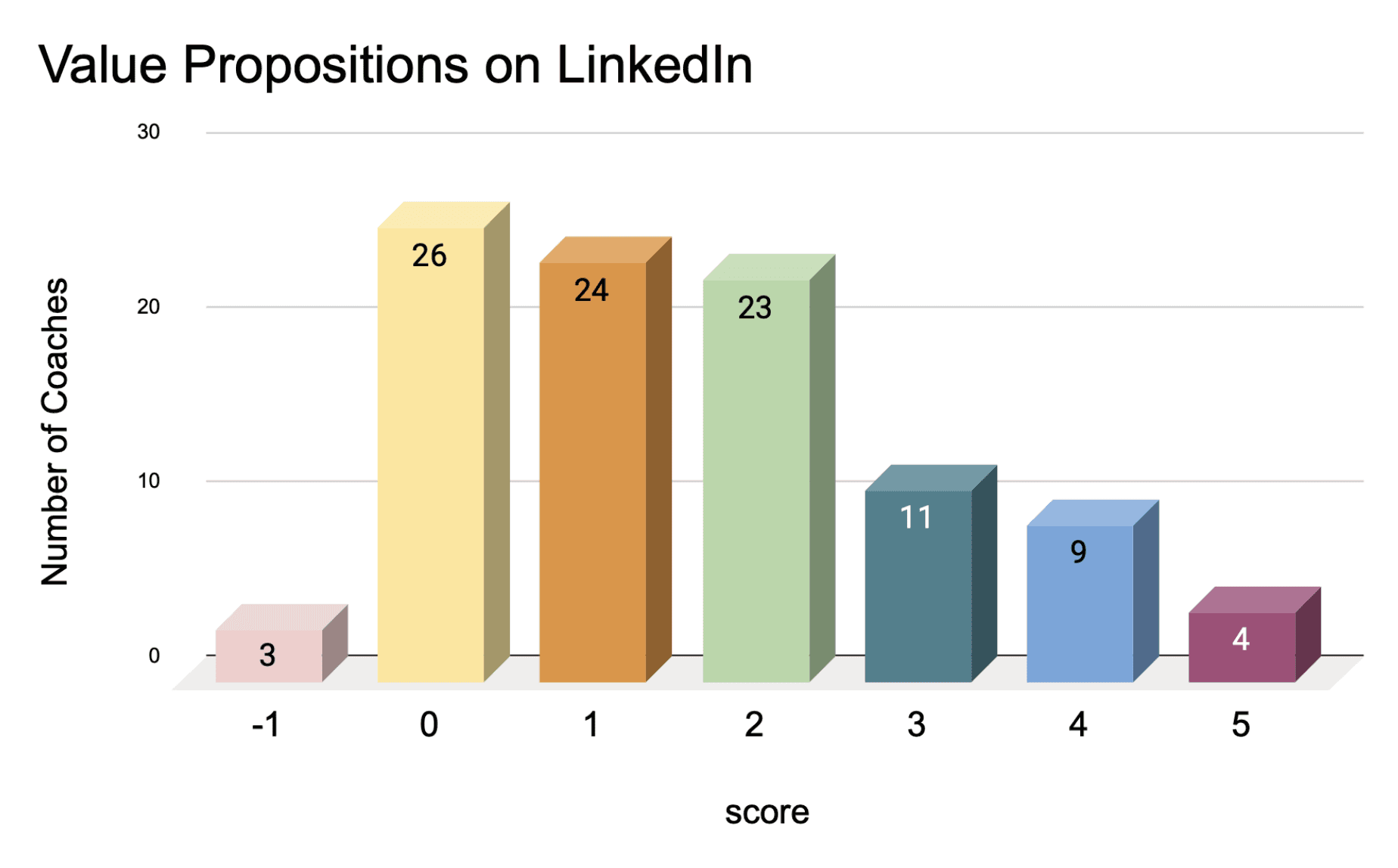
The pattern is clear: a third missing the mark, the majority doing okay to well, and a small number, 13%, bringing it home.
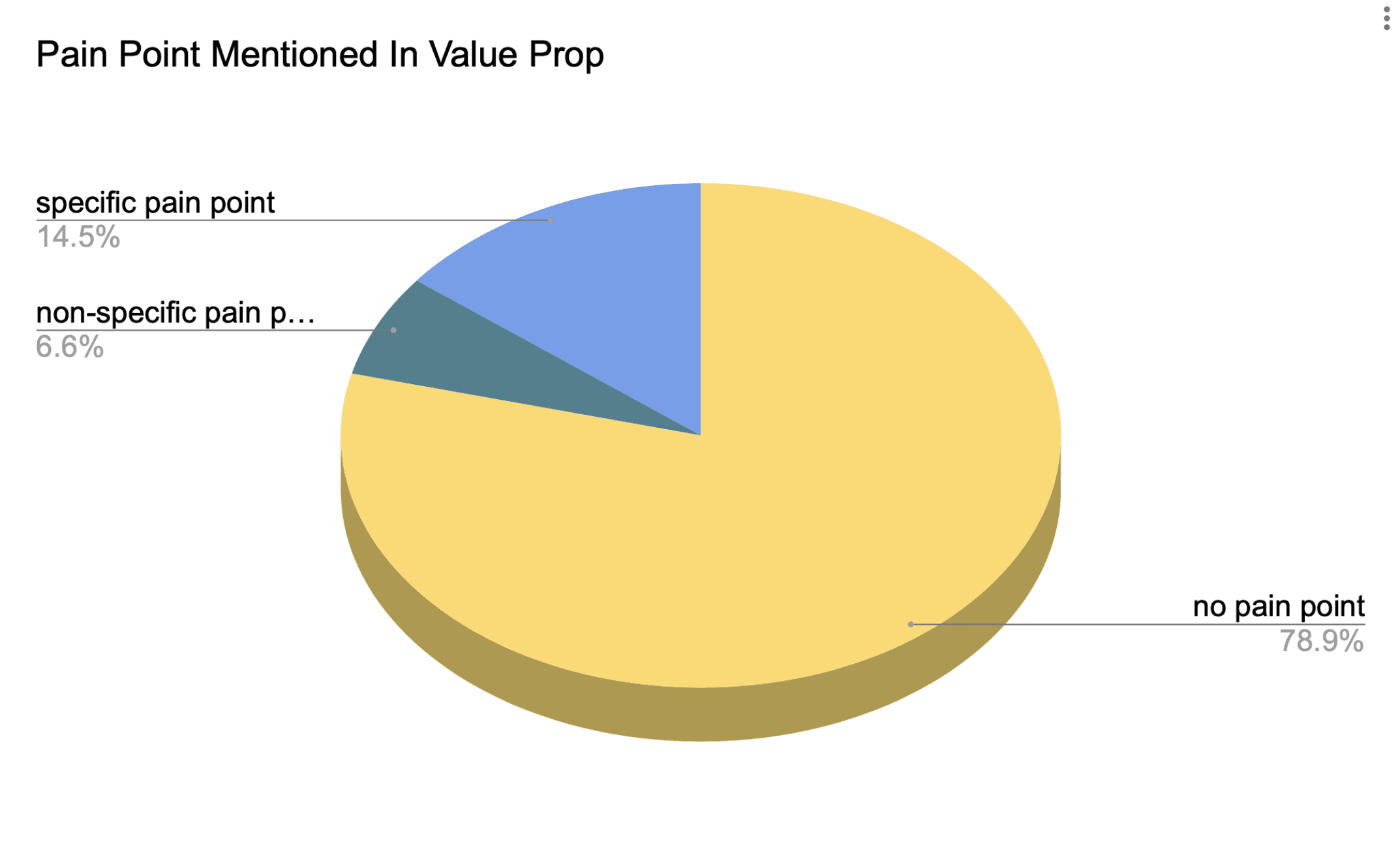
But dig deeper and the numbers get worse. Only 21% of coaches scored well on clarifying their niche in their LinkedIn value proposition. Only 14.5% mentioned the pain point/problem they were solving.
Website value propositions told a similar story:
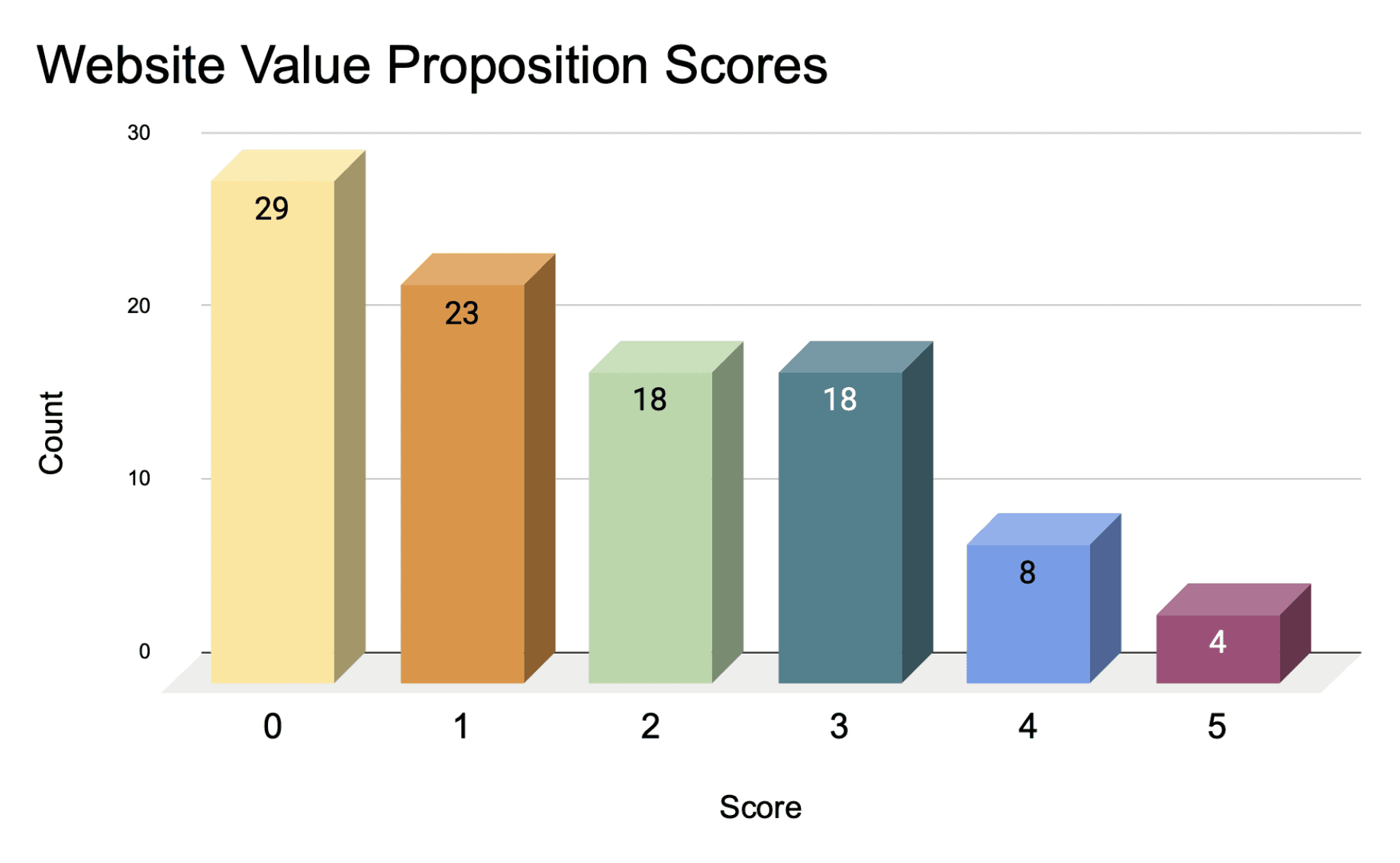
Only 12% of coaches scored well. That's 88% of coaches with underperforming value propositions.
Only 11% of coaches mentioned a specific niche in their website value proposition. 26% were specific about what problem they help solve. And the number of coaches who leveraged both niche and pain point? Just 4%.
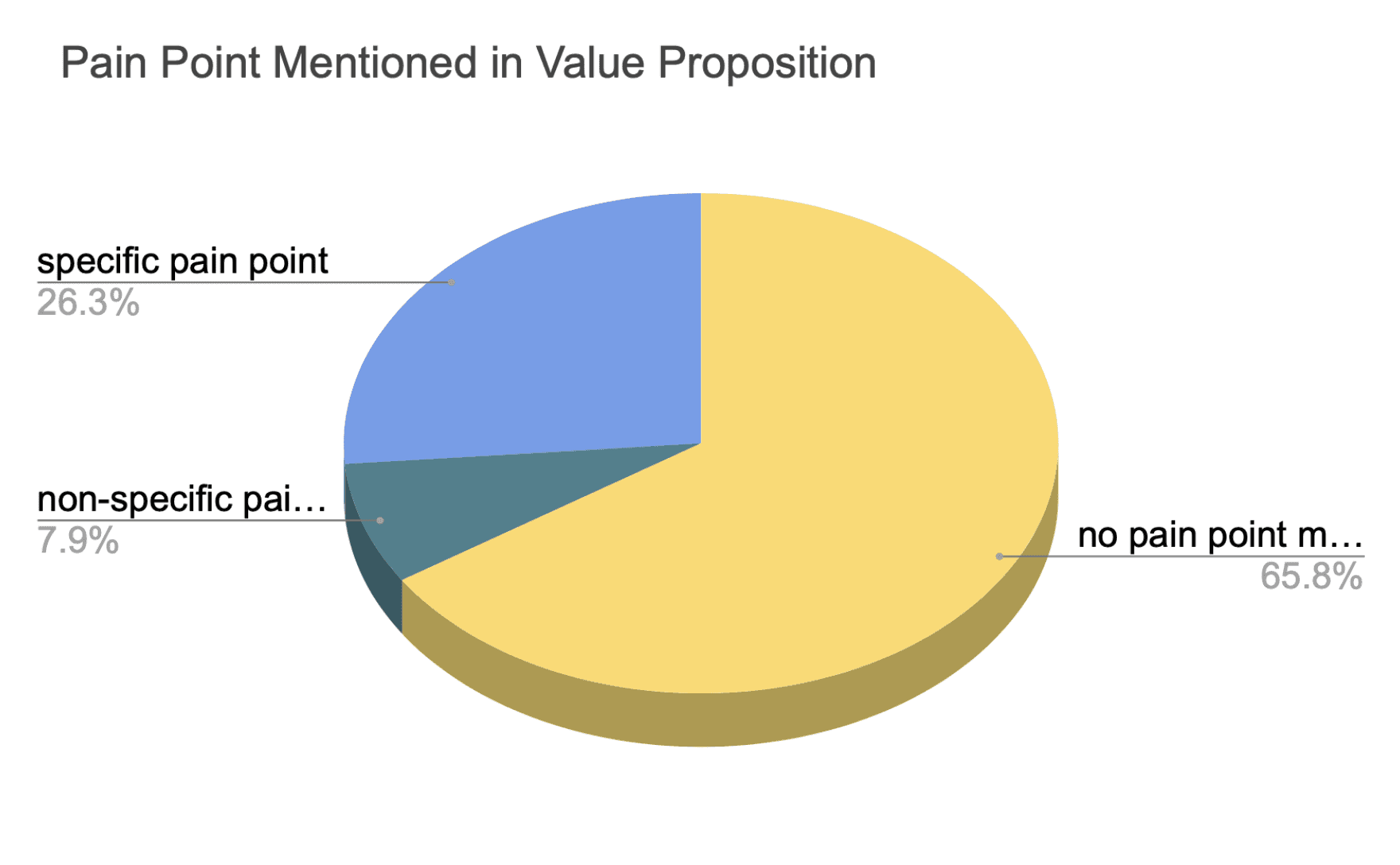
If you don't communicate your full value, you are effectively hiding it.
Do Business Coaches Keep Their Messaging Consistent Across LinkedIn and Their Website?
It's not enough to have a strong value proposition. It needs to be consistent.
What clients read on your LinkedIn should match what they read on your site. When those messages don't align, a potential client who finds you in two places gets two different versions of you. That creates confusion. Confusion kills trust.
Alignment breakdown (chart below table with the same information):
Alignment Level | Share of Coaches |
|---|---|
Strong Alignment | 12% |
Weak Alignment | 18% |
Mild Mismatch | 16% |
Strong Mismatch | 6% |
Missing Value Prop (no alignment possible) | 48% |
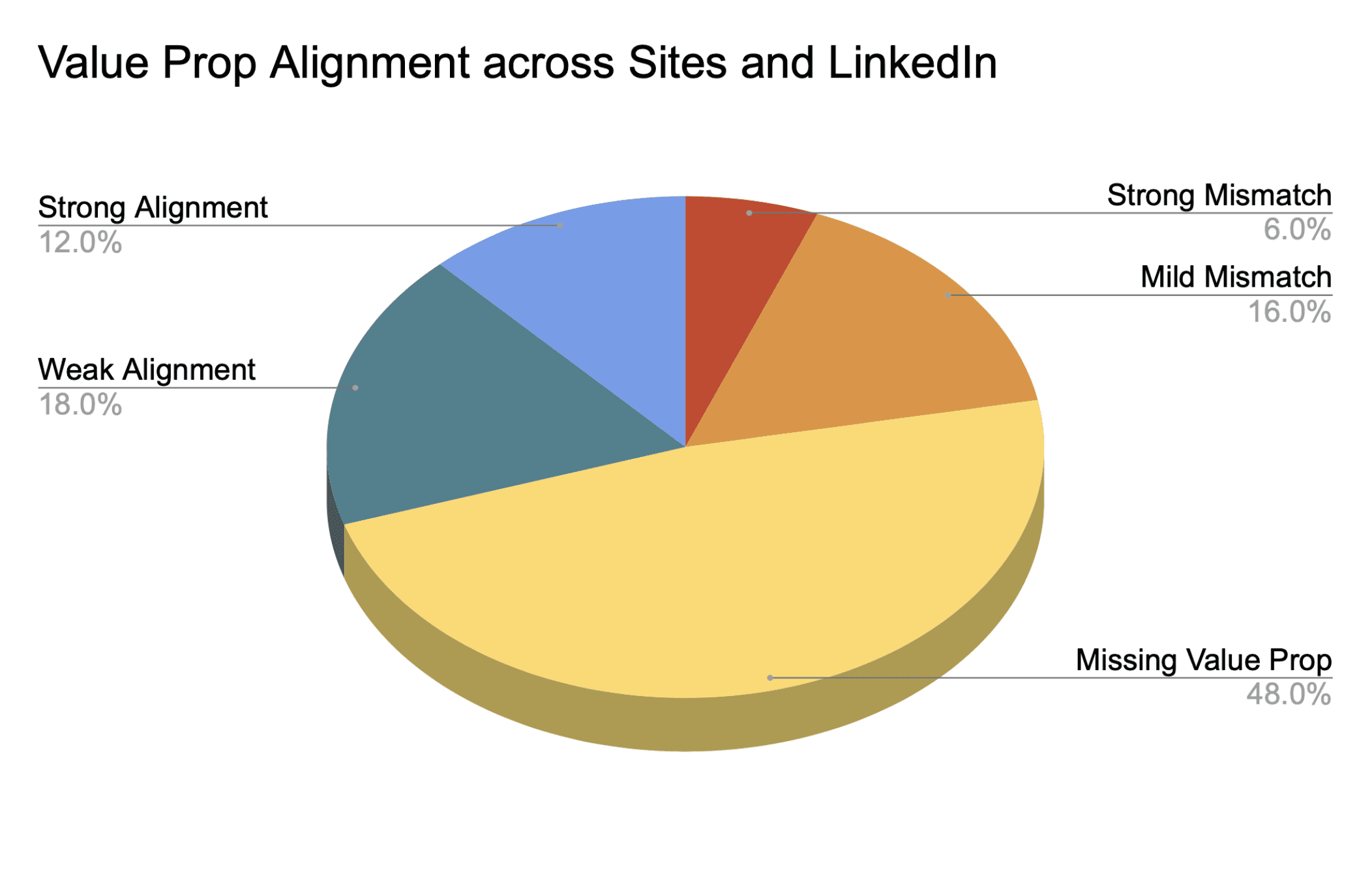
Only 12% of coaches passed this test.
Nearly half had no coherent value proposition to align in the first place. When value propositions don't align, it's a clear sign of disconnected marketing and fragmented strategy.
How Many Business Coaches Use a Lead Magnet/Gated Content and Does It Matter?
Lead magnets, or 'gated content' as they're often called in B2B, plus email marketing, remain an effective pipeline for business sales growth (4).
Yet most coaches don't have one. That's a missed opportunity.
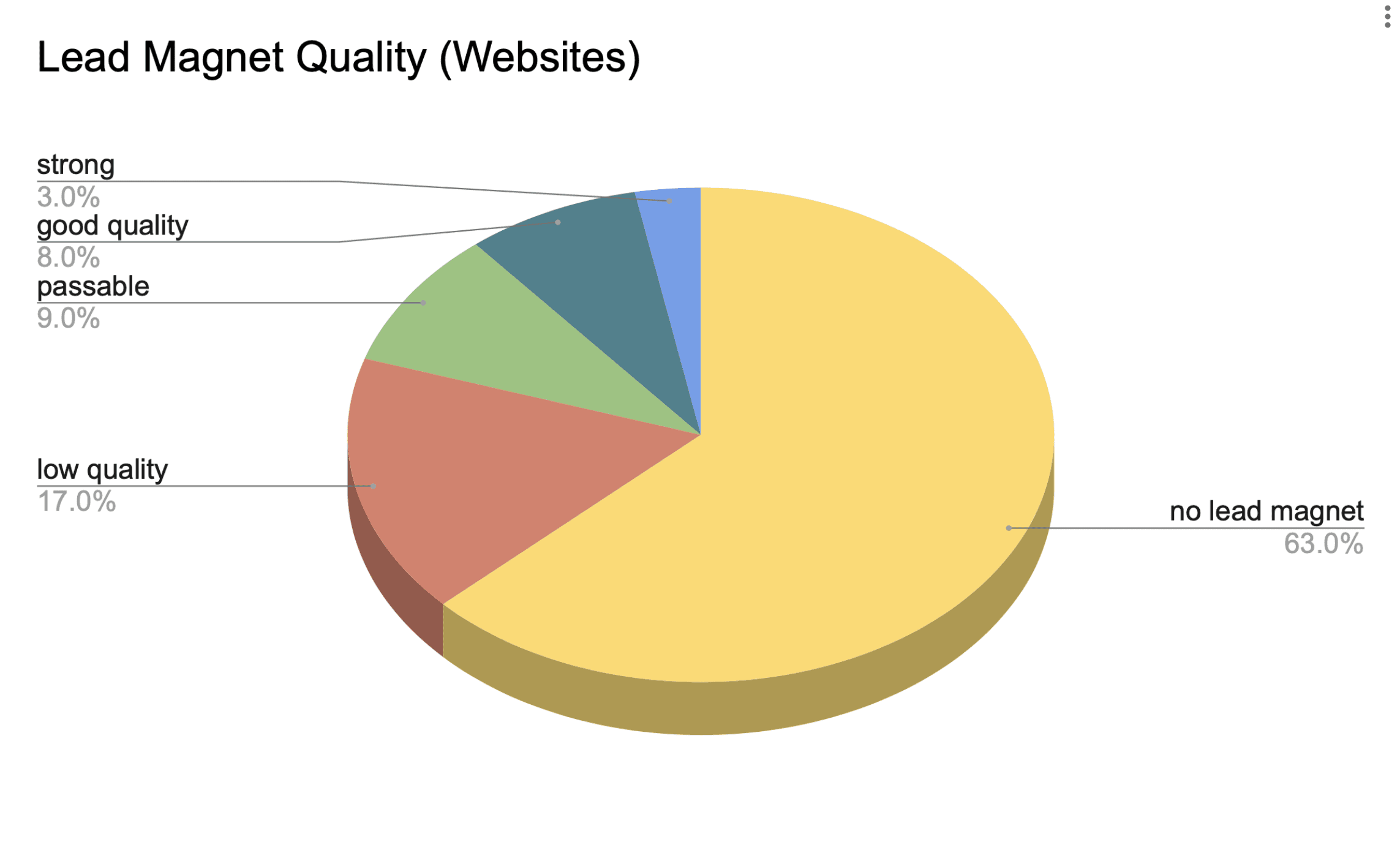
Website lead magnet presence:
Have one — 37%
No lead magnet — 63%
LinkedIn lead magnet presence:
Have one — 19%
No lead magnet — 81%
And of those who did have a lead magnet, the quality was generally low.
Website lead magnet quality (chart below table with the same information):
Quality | Share |
|---|---|
Strong | 3% |
Good | 8% |
Passable | 9% |
Low quality | 17% |
No lead magnet | 63% |
LinkedIn lead magnet quality (chart below table with the same information):
Quality | Share |
|---|---|
Strong | 3% |
Good | 4% |
Passable | 2% |
Low quality | 10% |
No lead magnet | 81% |
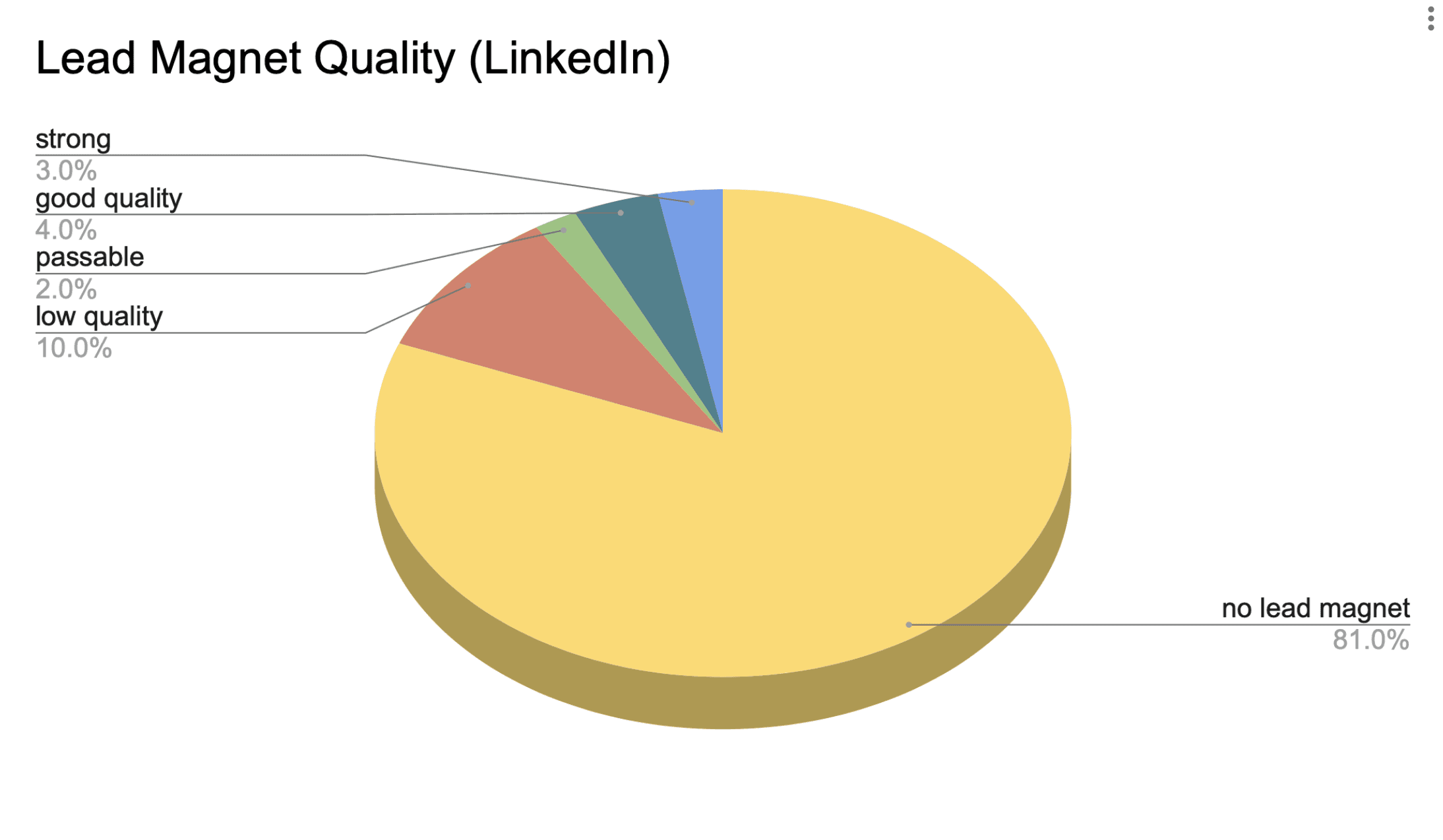
The number of coaches with even a passable score on LinkedIn or their site was very low.
A lead magnet is not essential, but they are a proven mechanism for capturing interest from a potential client who is not yet ready to buy. Without one, coaches are entirely dependent on visitors taking direct action at the first point of contact. Most won't. If you are against using one, consider an Information Kit your leads can request.
Did Coaches Present a Strong Offer?
Your value proposition is why clients will pay attention to you. Your offer is why they'll hire you.
To be clear, coaching is not the offer. Your offer is the package you wrap coaching in: how you deliver it, whether it's bundled, whether it's tied to outcomes, what extra support is included, and the price. Your offer is all the things the client is paying for, spelt out so they see the full value of hiring you.
This was an area where most coaches performed well.
Our coaches did well, with 75% having a good or strong offer (chart below table with the same information):
Offer Quality | Share |
|---|---|
Strong | 30% |
Good | 45% |
Passable | 15% |
No offer | 10% |
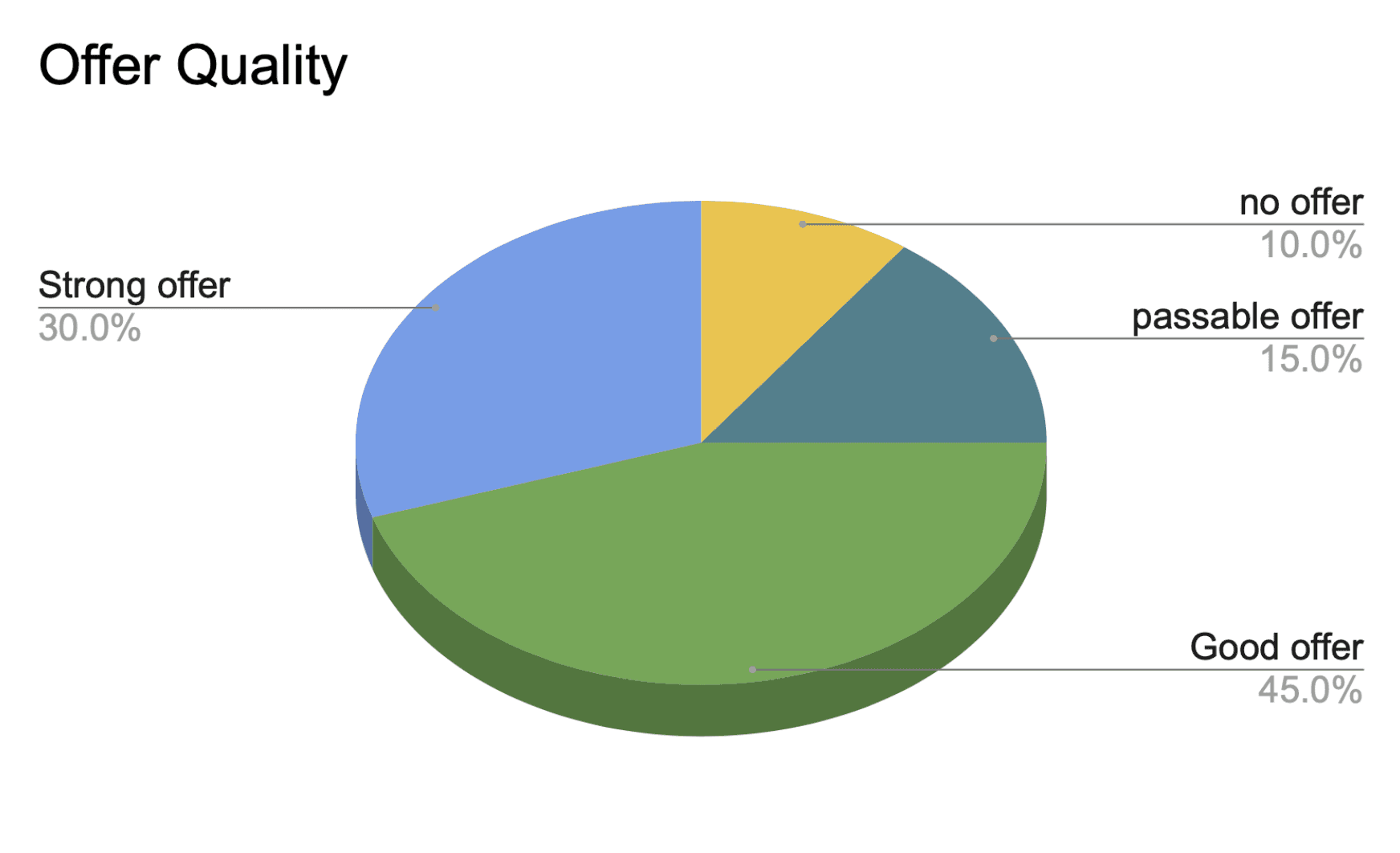
This tells us something important. Coaches understand their service. They struggle to communicate its value in the places clients look before they make contact.
N.B. For offers, I analysed 50 coaches instead of the full 100 (margin of error shifts to ±13.9%).
What Should a Business Coach's About Page Actually Do?
If a client visits your homepage and it passes muster, the next page they'll most likely visit is your about page. Think of your homepage as a public space where you greet visitors. Your about page is a side room where you both sit down with a coffee, so your visitor can get to know you. It's where you build trust and establish fit.
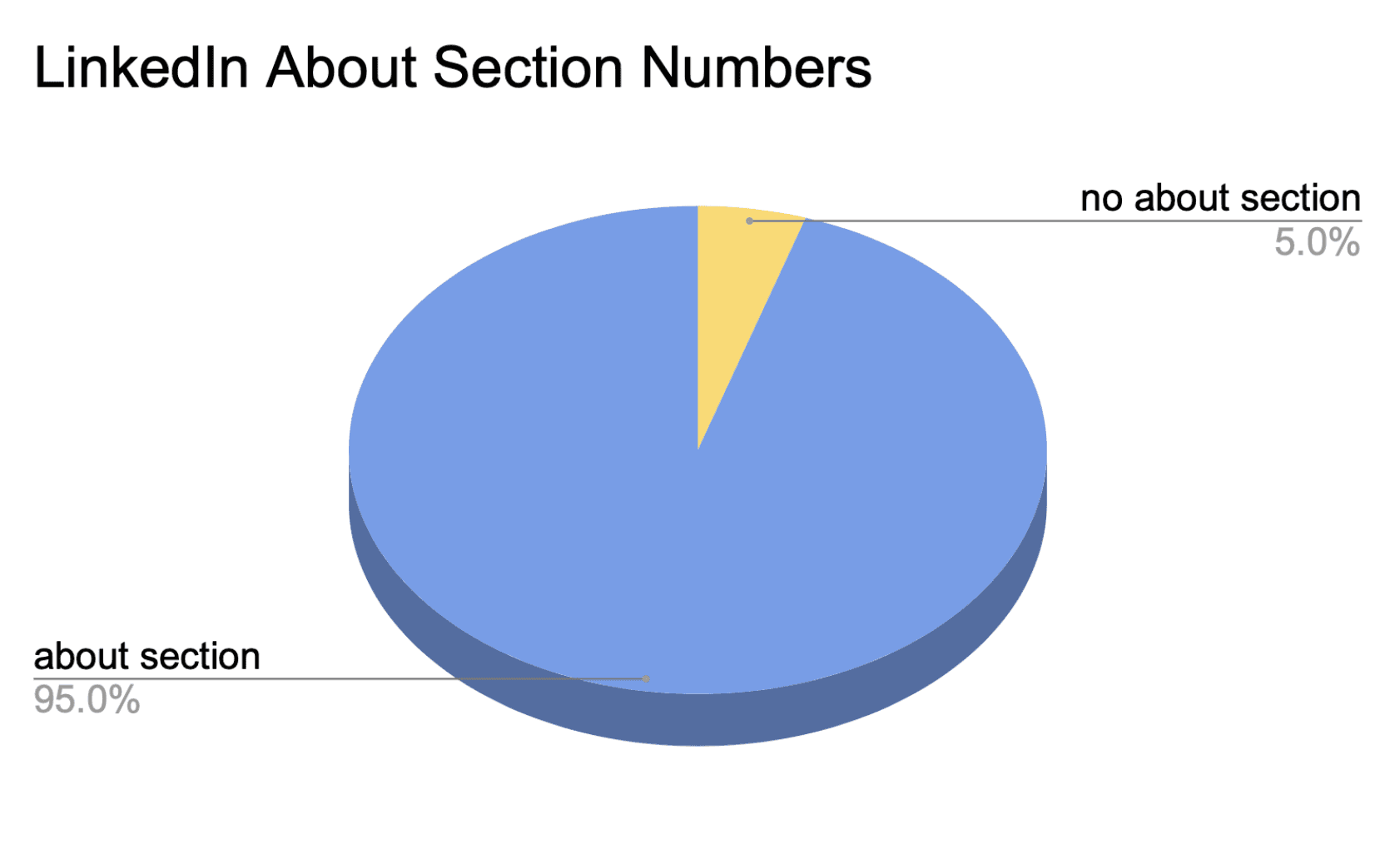
On LinkedIn, 95% of coaches had filled in their about section. But only 72.5% had an about page on their site.
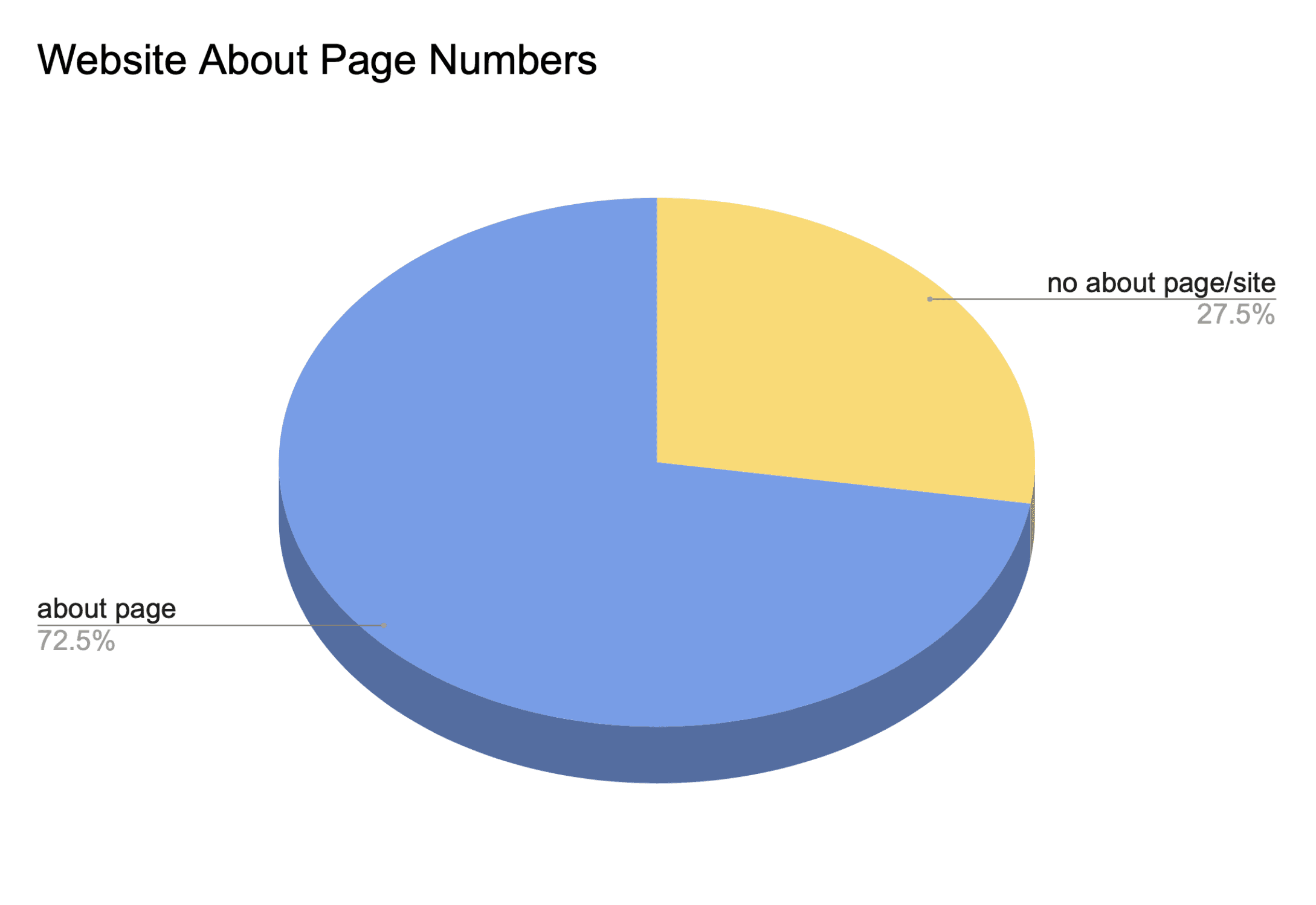
But what about quality? Here the scores go down.
Quality results:
Website: 60% scored good or strong
LinkedIn: 47% scored good or strong
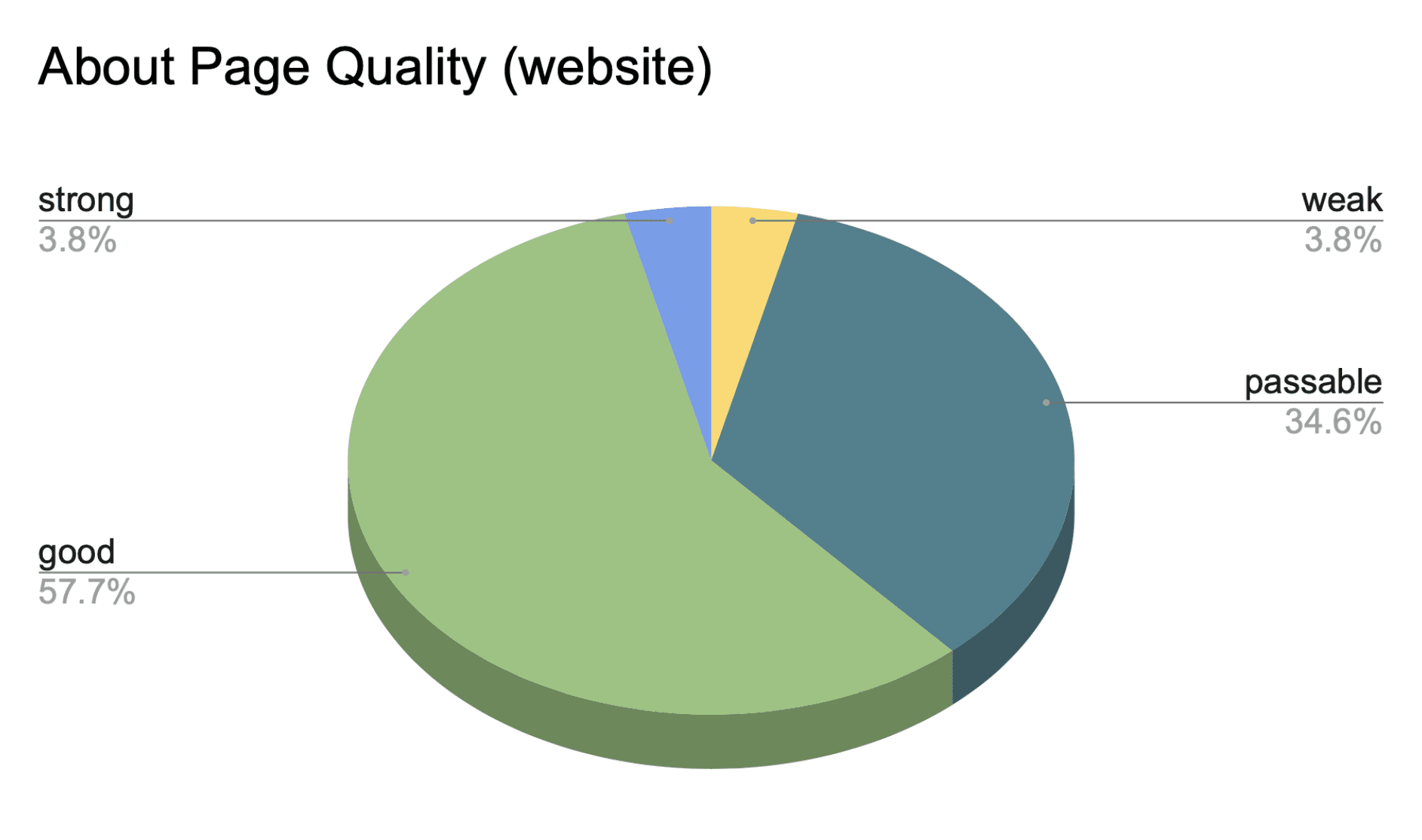
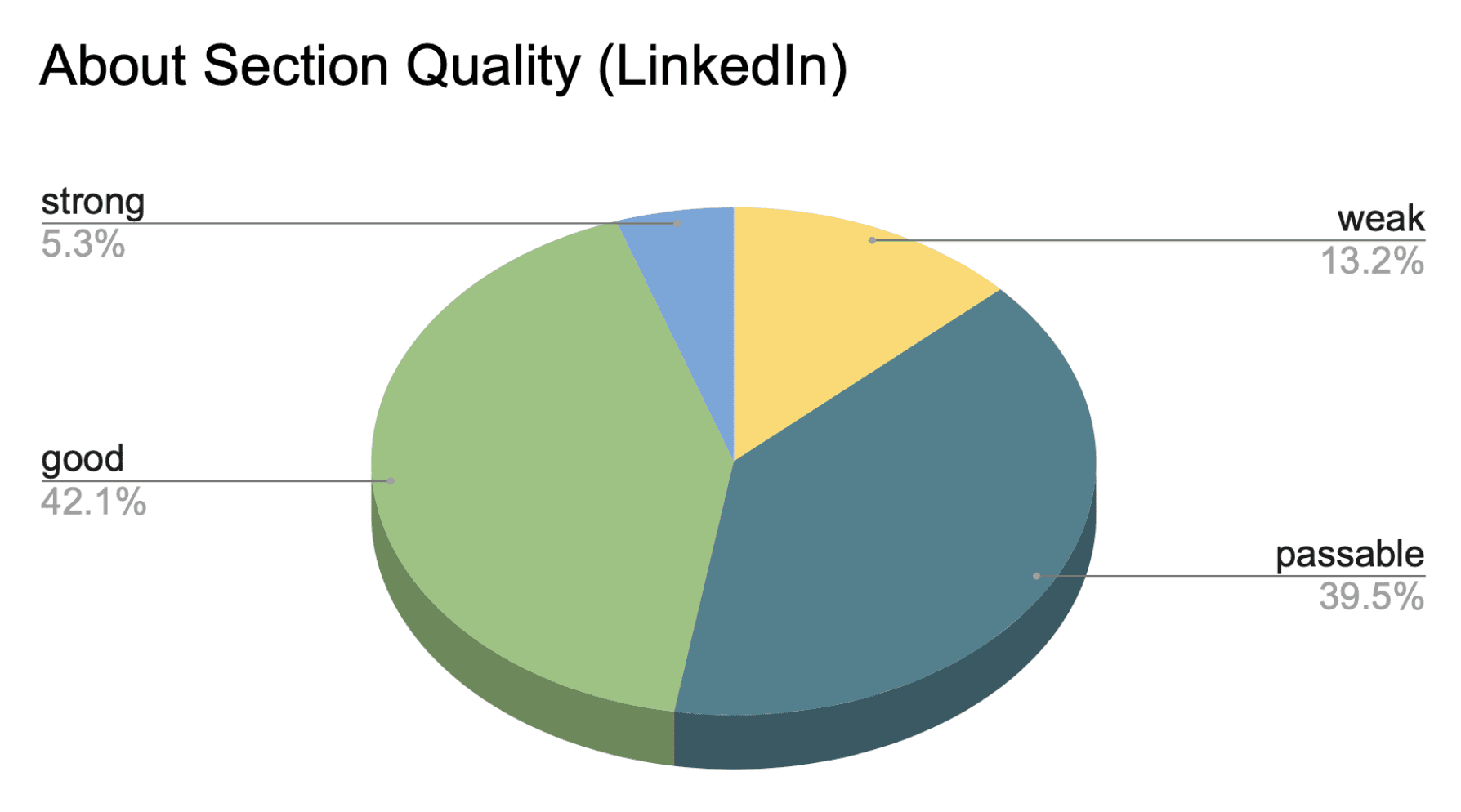
The biggest reason for scoring poorly was the writer's focus on themselves instead of their client. Yes, your about page is about you, but it's also about your client, how well you understand them, and why and how you're the best fit to help them. Think of your about page as a 'Why we belong together' page.
How Do You Make Sure Your Site is Easy to Read?
Want clients to read your content and site? Write at a 7th or 8th grade level (Irish 1st/2nd year, UK Year 8/9). That does not mean dumbing down your English. You can communicate complex and nuanced ideas better with simple language than complex language. But language complexity is a trap some coaches fall into.
Most coaches' clients are highly educated. That can make it tempting to write at a very high level. But high-level writing comes with a high cognitive tax, and that translates into fewer conversions.
Copy written at professional-level English converts at a median of 5.5%. Copy written at a 5th–7th grade level converts at 11.1% (5). That's a 100% boost.
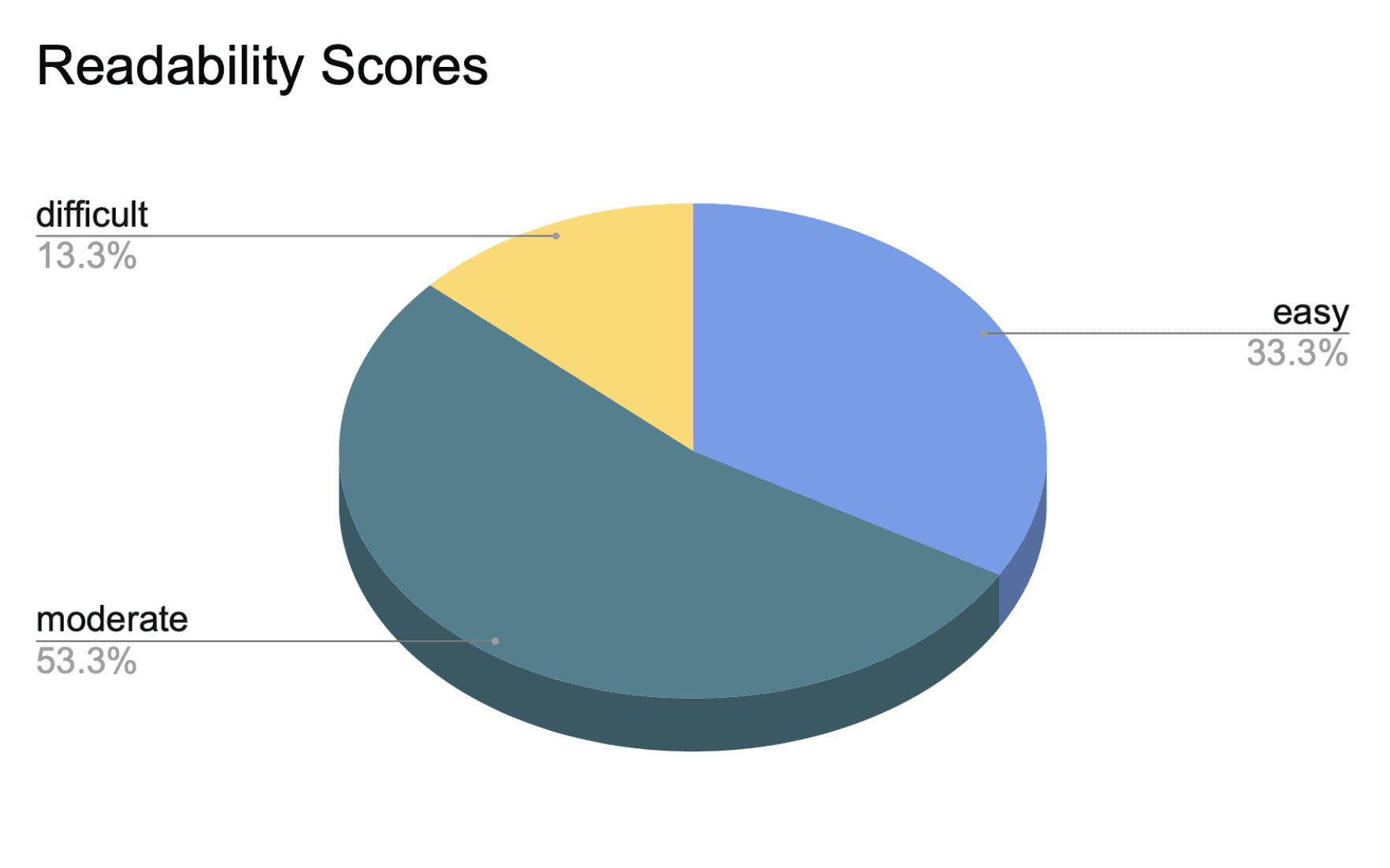
Readability scores (30 sites):
Easy — 33%
Moderate — 53%
Difficult — 13%
Writing clean and lean sentences will keep more of your ideal clients reading.
What Do the Top 3% of Business Coaches Do Differently?
Most coaches had what might be called jagged results; they would score well on a couple of categories but poorly on others.
I looked at coaches who scored highly across five areas: value propositions on LinkedIn and their site, value proposition alignment, and lead magnets on LinkedIn and their site.
Results:
No one scored well across all 5 or 6 categories
Only 3 coaches scored well across 4 categories
76% scored in zero or one categories
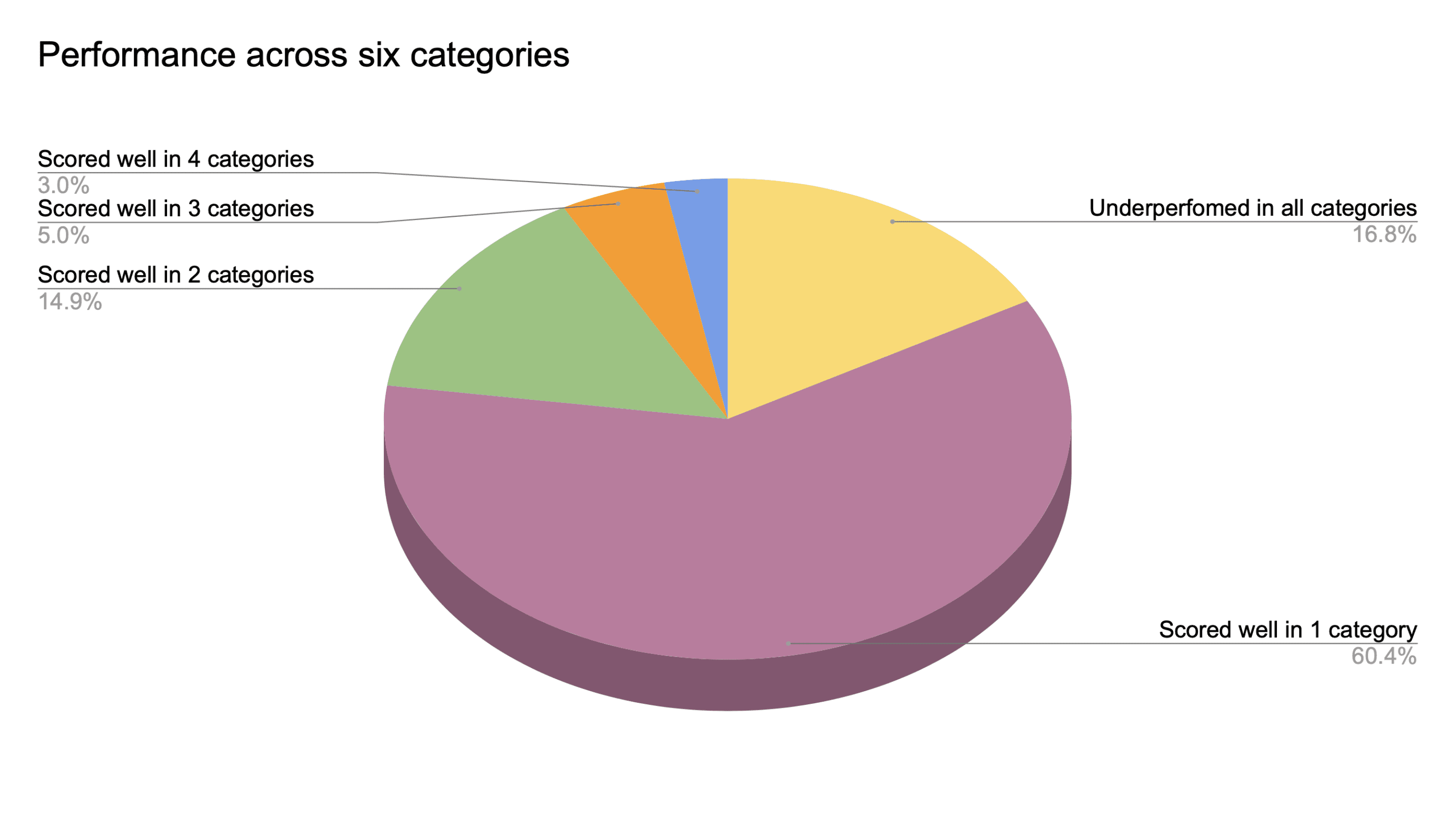
This is the clearest evidence we have that most coaches are under-communicating their value.
The coaches who came closest to the top shared a pattern: specific value propositions, consistent messaging across platforms, and a lead magnet that was directly relevant to the problem their ideal client was trying to solve. That combination (clarity, consistency, and a mechanism for capturing interest) separated the 3% from the rest.
What Can Irish and UK Business Coaches Learn from This Research?
This research was conducted on Forbes coaches from across the English-speaking world, including Ireland and the UK. While coaching in these two markets is more relationship-driven and more trust-sensitive, these results matter as they can be used to pinpoint your own marketing gaps and opportunities to develop clearer and higher-value messaging than competitors.
Digital visibility is increasingly how coaches get found, not just by Google, but by AI tools. When a potential client asks an AI assistant to recommend a leadership coach in Dublin or a business coach in London, the AI draws on publicly available information.
Coaches with clear, consistent, well-structured online marketing are more likely to appear in those recommendations than coaches with fragmented or unclear messaging.
By now, you should have a pretty good idea of why so many coaches feel invisible. It's because their marketing is under-communicating their value and relevance, or is simply silent.
But those gaps are also your opportunity. There are very few coaches out there with systematic and coherent messaging. Do that, and you have far more chance of being seen and valued by the clients who matter most to your business.
What Else Did the Research Reveal?
I didn't quantify them, but there are a few things that stood out as I worked through the data.
There were quite a few coaches who had paid for a professional website. They looked great, but the copywriting was usually poor and added very little above sites that were written by the coaches themselves.
Most coaches are DIYers and wrote at least part of their website themselves or used AI, and it hurt them.
The coaches who had the best and most coherent messaging are not even in this report. These were career coaches whom I had to filter out because they didn't fit the criteria. They were very good at explaining what they do, why it mattered, who they helped, and they did that coherently across all their marketing.
A lot of coaches, and I do mean a lot, jammed their LinkedIn profile summary and About section with credentials. That's fine, but not if that's all you do. Your marketing is a conversation with another person. It's about who you are for them, not just who you are.
A small, but not insignificant number, leaned into hyperbole. Claims like 'Change Messiah', 'Utterly Transform', 'Reach Maximum Potential' are not only a turn off to business-savvy people, but AI will instantly see them as 'puffery' and sin-bin you for it. The ONLY time you can use terms like these is when you have proof published right alongside ('Messiah' has a particularly high bar to clear for that).
Running any business is hard, and I imagine none of the one hundred coaches I reviewed got into coaching because they were excited about marketing. But unless you have an exceptional network and a results book that has people knocking on your door, you are a marketer. And that's actually good news. Because you can become good at it and most of your competition won't.
2026 Update
2026 Update: How Has AI Changed How Business Coaches Are Found and Vetted by Their Future Clients?
As I said, my research was carried out in Q2 2025. A lot has happened since then.
AI search is changing how buyers find and evaluate service providers, including business coaches. When a potential client asks ChatGPT or Perplexity to recommend a leadership coach in Galway or Manchester, the AI doesn't return ten pages of results. It returns a short list. Everyone else is invisible.
This is not a future concern.
McKinsey (2026) found that 67% of UK consumers used at least one AI tool in the last three months for researching and comparing purchases. Gartner predicts, "By 2028, 90% of B2B buying will be AI agent intermediated, pushing over $15 trillion of B2B spend through AI agent exchanges."
For business coaches, this creates a new and urgent problem on top of the ones identified in this research. A coach with a weak value proposition, fragmented messaging, and no lead magnet was already losing clients to better-marketed competitors. Now they are also invisible to AI, which means invisible to the buyers who use it to build their shortlists before making contact with anyone.
The good news is that the same things that make your marketing clear to a human make it readable to an AI. Clear value propositions, consistent messaging across platforms, structured content, and a demonstrable niche all signal to AI systems that your business is real, relevant, and worth recommending. That work is called Generative Engine Optimisation (GEO).
The core idea in GEO is signal clarity. Every piece of missing, inconsistent, or poorly structured information makes it harder for an AI system to resolve what your business is, what it does, and why it should be trusted. When it comes to recommendations, AIs are risk-averse. If they have doubts about who you are and who you serve, you are out of the running.
Princeton University research published at ACM KDD 2024 showed that structured content optimisation can improve AI visibility by up to 40%. That is meaningful. But it only works if the underlying marketing, the value proposition, the niche, and the consistent messaging is already in place.
Coaches who take care of this, step ahead of 97% of their competition.
Further Reading:
If you have a question or would like to chat about your marketing, you can reach me HERE.
If you'd like to see how I improved my own onsite GEO scores from 45 to 95, read HERE.
If you'd like to understand the difference between AI SEO and GEO, read HERE.
Methodology:
Data collection | Detail |
|---|---|
Source | LinkedIn Sales Navigator longlist of 300+ coaches, cross-referenced with Forbes Coaches Council membership |
Data used | Public-facing data only |
AI tools | Used for readability scoring only. (I tried AI tools for quality assessment, but they proved unreliable.) |
Anonymity | No coaches identified by name. Neither Forbes nor LinkedIn were contacted |
Scoring framework | Criteria |
|---|---|
Value propositions | Clarity, niche, pain point, mechanism, credibility, specific outcomes |
Lead magnets | Clarity, value proposition, relevance, delivery format, desirability, friction |
About copy | Empathy, client focus, outcomes/future states, proof elements, CTAs |
Offers | Clarity, value propositions, delivery, support, outcomes |
Metric | Sample size | Margin of error |
|---|---|---|
Value propositions, niching, alignment, lead magnets | 100 | ±9.5% |
Offers | 50 | ±13.9% |
About pages | 40 | ±15.5% |
Readability | 30 | ±15% |
Disclaimer:
FORBES® is a registered trademark of Forbes Media LLC. This publication is an independent analysis of publicly available information and is not endorsed by, affiliated with, or sponsored by Forbes Media LLC. All other trademarks are the property of their respective owners and are used for identification purposes only. Use of such marks does not imply endorsement. This report is for informational purposes only and does not constitute legal, tax, or financial advice. Past performance, case studies, and benchmark data do not guarantee future results.
Sources:
(1) Netline: 2025 State of B2B Content Consumption & Demand Report: https://www.netline.com/netline002n/?d=consumption25&k=2503nlwccr
(2) Unbounce: Conversion Benchmark Report: https://unbounce.com/conversion-benchmark-report/
(3) McKinsey: https://www.mckinsey.com/industries/consumer-packaged-goods/our-insights/an-update-on-european-consumer-sentiment
(5) Princeton: GEO: Generative Engine Optimization" Aggarwal et al., Princeton University, published ACM KDD 2024: https://arxiv.org/abs/2311.09735
Details
Category
Marketing
Reading
12 minutes
Author
Paul Melrose
Paul is a Strategic Direct-Response Business Copywriter and Consultant based in Dublin, Ireland.
More articles